Design Insights
Natural Stone Applications in Custom Kitchens
Explore natural stone applications in custom kitchens and their applications in custom cabinetry and luxury kitchen design.
A Comprehensive Guide to Stone Selection, Application, and Care
Natural Stone in the Luxury Kitchen
Natural stone remains the definitive surface material in luxury kitchen design. No engineered product—however technically superior—can replicate the depth, character, and presence of a slab of Calacatta marble, the dramatic veining of Patagonia quartzite, or the soft, matte warmth of honed soapstone. Stone is geological art: each slab is unique, formed over millions of years by the specific pressures, minerals, and temperatures of its source. Selecting the right stone for your kitchen is one of the most significant aesthetic and functional decisions in the entire design process.
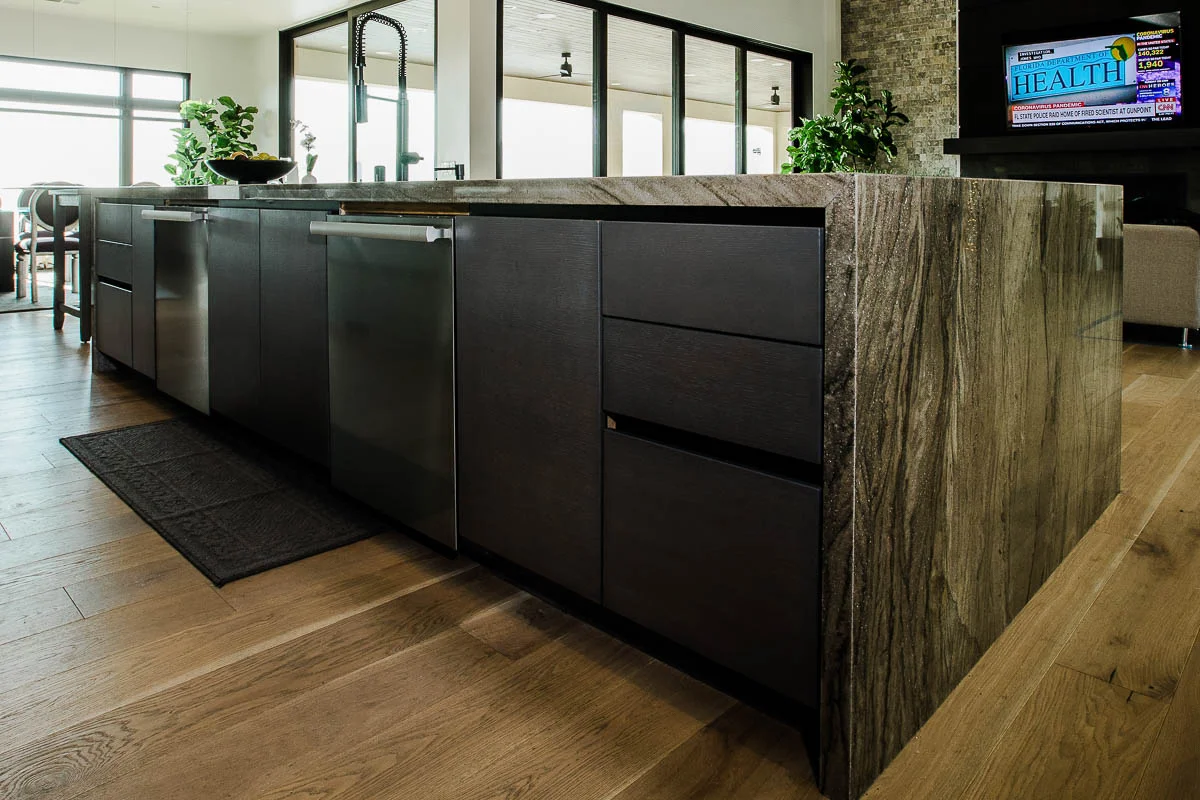
At PineWood Cabinets, we design cabinetry to complement and showcase natural stone rather than compete with it. The relationship between wood and stone is one of the most powerful material pairings in design—warm grain against cool veining, organic texture against polished surface, the crafted against the geological. Getting this relationship right requires understanding both materials deeply and selecting them in concert, not in isolation.
This guide covers the major stone categories used in California luxury kitchens, their properties, their ideal applications, and how they interact with custom cabinetry. For countertop-specific comparison, see our article on quartz versus granite.
Marble: The Timeless Icon
Marble has been the surface of choice in grand kitchens for centuries, and its appeal endures for good reason. Calacatta marble—quarried in the Apuan Alps of Tuscany—features a warm white base with bold, dramatic veining in gold, gray, and sometimes violet. Calacatta Borghini, Calacatta Viola, and Calacatta Gold are our most-requested varieties, each with distinct veining character. Carrara marble, from the same region, offers a cooler white base with softer, more feathery gray veining—a subtler beauty that works particularly well in transitional and traditional kitchens.
The honest truth about marble is that it etches and stains. Acids—lemon juice, wine, tomato sauce—will leave dull marks on a polished marble surface. This is a chemical reaction, not a maintenance failure, and it cannot be entirely prevented. Many of our clients embrace this quality, viewing the patina of use as character that enriches the stone over time. Others prefer to use marble strategically—on the island as a showpiece and visual centerpiece, while specifying a more forgiving stone on the perimeter counters where daily cooking happens.
Honed marble (matte finish) shows etching far less than polished, making it our recommended finish for countertop applications. The softer surface also pairs more harmoniously with warm wood cabinetry, creating a relaxed, European sensibility. For backsplash applications, where the stone is vertical and not subject to food preparation, polished marble can be used without concern about etching.
Quartzite: Beauty Meets Durability
Quartzite has emerged as the stone of choice for clients who want the dramatic beauty of marble with significantly better durability. True quartzite—a metamorphic rock formed from sandstone under extreme heat and pressure—is harder than granite, resistant to etching, and nearly impervious to scratching. It is the ideal surface for luxury kitchens where both beauty and performance are non-negotiable.
The quartzite varieties currently dominating our projects include Taj Mahal (a warm, creamy base with soft gold veining—our single most-specified stone), Calacatta Macaubas (white base with gray veining that mimics Calacatta marble), Super White (a near-pure white with subtle movement), and Patagonia (dramatic brown-and-gold veining on a warm cream base). Each of these stones delivers visual drama comparable to marble while handling daily kitchen use with far greater resilience.
One important caveat: the term "quartzite" is frequently misapplied in the stone industry. Some stones sold as quartzite are actually dolomitic marble or other softer stones that lack true quartzite's hardness. We test every slab before specification using a simple scratch test and acid test. True quartzite will not scratch with a knife and will not etch with lemon juice. Insist on verified quartzite, especially for island installations where the stone bears the heaviest use.
Granite: Enduring Performance
Granite has been somewhat overshadowed by quartzite and marble in recent trend cycles, but it remains an excellent choice—particularly in leathered and honed finishes that align with current design preferences. Leathered granite has a subtle, textured surface that hides fingerprints, water spots, and minor imperfections while providing exceptional hardness and heat resistance. It is virtually indestructible in a kitchen environment.
The granites generating the most interest among our clients include Steel Grey (a dramatic near-black with subtle crystalline flecking), Bianco Antico (warm gray with burgundy and cream mineral deposits), and Colonial Gold (a warm neutral with veining that pairs beautifully with walnut cabinetry). For mountain homes and wine country kitchens, where the material palette favors earth tones and natural textures, granite is often the most contextually appropriate choice.
Soapstone: The Chef's Stone
Soapstone occupies a special place in kitchen design—beloved by serious cooks for its unique combination of properties. It is naturally non-porous (requiring no sealing), impervious to acids and stains, heat-resistant enough to set a hot pot directly on its surface, and develops a beautiful natural patina over time. Its soft, matte gray surface has a tactile warmth that cold marble and granite cannot match—it genuinely feels good under your hands during food preparation.
The trade-off is that soapstone is relatively soft and will scratch. However, scratches can be sanded out with fine sandpaper (220 grit) and the surface restored with mineral oil in minutes—a maintenance simplicity that no other natural stone offers. Many of our clients appreciate the living quality of soapstone, where the marks of use become part of the stone's character. We pair soapstone with warm wood cabinetry—walnut, cherry, or fumed white oak—where the combination creates a deeply inviting, European farmhouse sensibility.
Stone as Backsplash and Full-Height Application
One of the most dramatic trends in luxury kitchen design is the extension of countertop stone up the backsplash wall—from counter to ceiling—creating a monolithic surface that showcases the stone's full drama. Full-height stone backsplashes are particularly stunning with heavily veined marbles and quartzites, where the veining pattern can be oriented and bookmatched to create sweeping compositions that function as large-scale abstract art.
From a cabinetry perspective, full-height stone backsplashes require careful coordination. Upper cabinets are either eliminated on the stone wall (creating an open, gallery-like presentation), or floated in front of the stone with a reveal gap that allows the veining to continue behind and between the cabinets. We mount floating upper cabinets on concealed French cleat systems that provide solid support while maintaining the illusion that the cabinets hover in front of the stone wall. LED strips mounted behind the upper cabinets wash the stone surface with warm light, accentuating the veining patterns dramatically after dark.
Natural stone is one of the great pleasures of kitchen design—a material that connects the built environment to the natural world in a way nothing artificial can replicate. When selected with knowledge and paired with fine cabinetry, stone elevates a kitchen from a functional space to an experiential one. Contact us to discuss how natural stone can transform your kitchen project, or explore our full materials library.
Continue exploring kitchen design excellence