Design Insights
Touchless Technology in Kitchen Design
Explore touchless technology in kitchen design in modern luxury kitchen design and functionality.
Integrating Touchless Technology Without Compromising Design
Hands-Free, Hassle-Free
Touchless technology in the kitchen has moved well beyond the motion-sensor faucet. Today's luxury kitchens incorporate hands-free operation across faucets, cabinet hardware, lighting, waste systems, and appliances -- creating environments that are more hygienic, more convenient, and, when integrated thoughtfully, more beautiful than their manually operated counterparts. The challenge lies not in finding the technology but in incorporating it seamlessly into high-end cabinetry and design.
At PineWood Cabinets, we have installed touchless systems in kitchens across California, from tech-forward homes in Silicon Valley to design-conscious properties in Los Angeles. Our experience has taught us which technologies deliver genuine value, which are gimmicks, and -- most importantly -- how to integrate them so they enhance rather than clutter the kitchen's design language. This guide shares that perspective with homeowners considering touchless upgrades for their custom kitchens.
Touchless Faucets: The Workhorse of Hands-Free Kitchens
Motion-activated kitchen faucets have matured significantly since their early days of unreliable sensors and utilitarian aesthetics. Premium brands now offer sensor-equipped faucets in every style from traditional bridge to minimalist bar, with sensors sophisticated enough to distinguish between a hand reaching for water and a pot being placed in the sink. Kohler's Sensate and Moen's MotionSense Infinity lines are our most-specified options, combining reliable sensor technology with designs that complement luxury cabinetry.
The Kohler Sensate uses a capacitive sensor that activates with a simple wave of the hand within two inches of the spout -- no need for the wide sweeping motion older sensors required. It also features a manual handle for precise temperature control, so you are never locked into sensor-only operation. Delta's Touch2O Technology takes a different approach, activating with any touch on the faucet body -- useful when your hands are full but not completely touchless.
For integration into custom cabinetry, the critical consideration is power supply. Most touchless faucets require either AC power (a standard outlet under the sink) or battery power. We always recommend the AC-powered option, wiring a dedicated outlet into the sink cabinet during rough electrical. Battery-powered sensors work adequately but require periodic replacement, which means accessing the space under the sink -- less convenient in a carefully organized cabinet interior. We plan for these utilities during our design phase.
Touch-Latch Cabinet Hardware: Clean Lines, No Handles
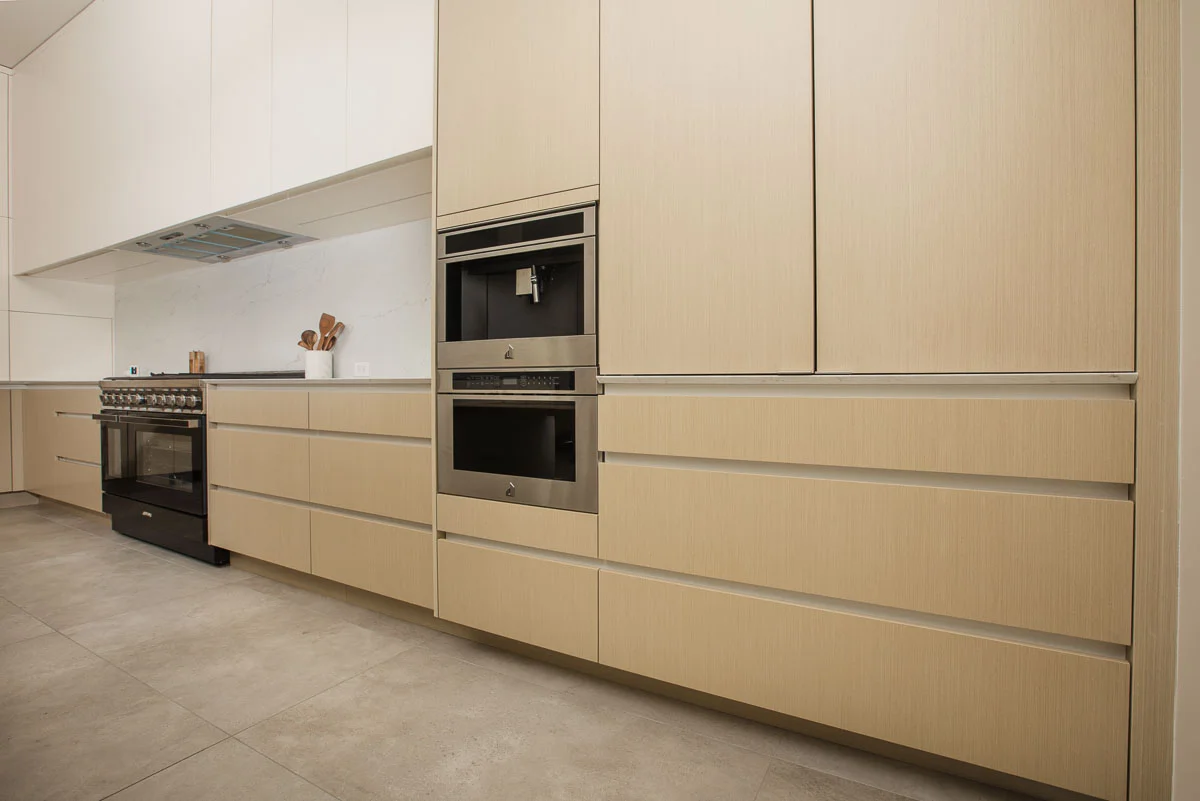
For homeowners who want the sleek, handleless look of European contemporary kitchens, touch-latch (tip-on) cabinet hardware offers a compelling solution. Blum's TIP-ON system allows cabinet doors and drawers to open with a light push on the front surface, eliminating the need for visible handles or pulls. The door springs open just enough to grasp, then closes with Blum's standard BLUMOTION soft-close mechanism.
We have used TIP-ON extensively in contemporary kitchens throughout the Bay Area, where handleless design is particularly popular. The system works flawlessly on both doors and drawers, and the mechanical components are hidden entirely behind the cabinet front, maintaining perfectly clean sight lines. For tall pantry cabinets, TIP-ON BLUMOTION combines the push-to-open function with a servo-drive motor that powers the door fully open -- particularly useful for heavy pantry doors loaded with pull-out shelving.
One practical consideration: touch-latch cabinets show fingerprints more readily than handle-operated ones because fingers contact the door face directly. We recommend matte or textured finishes for touch-latch kitchens -- wire-brushed wood, matte lacquer, or fenix NTM laminate (which actually self-heals micro-scratches). High-gloss surfaces will require more frequent cleaning to maintain their appearance.
Automated Waste and Recycling Systems
The waste bin cabinet is one of the most frequently accessed locations in any kitchen, and also one of the most hygienically sensitive. Touchless waste systems solve both problems elegantly. Sensor-activated waste bin lids open automatically when you approach, allowing hands-free disposal of food scraps and packaging. Simplehuman's sensor cans are the consumer-grade standard, but for built-in applications, we prefer the Blum SERVO-DRIVE waste system that opens the entire cabinet front when activated.
The SERVO-DRIVE waste system integrates directly into the cabinet and operates on a foot-activated kick sensor mounted at the toe kick. A light tap with your foot opens the cabinet door, revealing the waste and recycling bins inside. The door stays open for a preset time, then closes automatically with soft-close dampening. For homes with multiple waste streams -- compost, recycling, and landfill -- this system makes sorting effortless, even when your hands are occupied with food prep.
We design the waste cabinet to accommodate the specific bin configuration each client needs. In California, where composting is increasingly mandated, a three-bin system is becoming standard: a large bin for recycling, a medium bin for landfill, and a small bin for compost. The cabinet interior is fitted with removable liners for easy cleaning and can include a carbon filter insert in the door to control odors.
Motion-Activated Lighting in Cabinetry
Interior cabinet lighting that activates when a door or drawer is opened is one of the most practical and universally appreciated touchless technologies. It transforms deep cabinets and drawers from dark cavities where items disappear into fully illuminated storage where everything is visible and accessible. We install LED strip lights inside every cabinet and drawer, activated by magnetic reed switches that detect when the door or drawer opens.
For under-cabinet task lighting, occupancy sensors provide hands-free activation. Walk into the kitchen and the under-cabinet lights illuminate automatically, turning off after a preset period of inactivity. We pair these sensors with tunable-white LED strips from Hafele or WAC Lighting that adjust color temperature from warm (2700K) in the evening to cool (4000K) during daytime food preparation, supporting natural circadian rhythms.
The wiring for these systems is planned during the design phase and concealed within the cabinet structure. No visible wires, no exposed sensors, no aftermarket appearance. The technology is present but invisible -- which is exactly how it should be in a luxury kitchen. Explore how we integrate technology into our custom kitchen designs.
Smart Appliances with Touchless Operation
Major appliance manufacturers are integrating touchless controls into their premium lines. The Miele Generation 7000 series offers M Touch displays with proximity-activated screens that wake when you approach and sleep when you walk away. Gaggenau's full-surface induction cooktops respond to the placement of cookware, automatically detecting pot size and position without any manual input.
Refrigerator manufacturers are leading in touchless innovation. LG's InstaView Door-in-Door feature allows you to knock twice on the glass panel to see inside without opening the door, reducing cold air loss. Samsung and GE Profile offer built-in cameras that let you check refrigerator contents from your phone while grocery shopping. For panel-ready built-in models that we integrate into custom cabinetry, these smart features are accessible through the appliance's companion app rather than through visible external displays.
The key to successful touchless appliance integration is ensuring that the cabinetry design accommodates the technology's requirements. Touchscreen panels need adequate clearance for viewing angles. Wi-Fi-connected appliances need reliable signal strength, which may require an access point near the kitchen. Power requirements for features like auto-door refrigerators must be planned during electrical rough-in. These details are invisible in the finished kitchen but critical to getting right.
Continue exploring kitchen technology and innovation
Related Articles
Voice-Activated Kitchen Features
Hands-free control through voice commands in luxury kitchens
Read More →Virtual Reality Design Visualization
Experience your kitchen before it is built with VR technology
Read More →