Design Insights
Wood Grain Matching Techniques for Seamless Design
Explore wood grain matching techniques for seamless design and their applications in custom cabinetry and luxury kitchen design.
The Art of Continuous Grain in Custom Cabinetry
Introduction
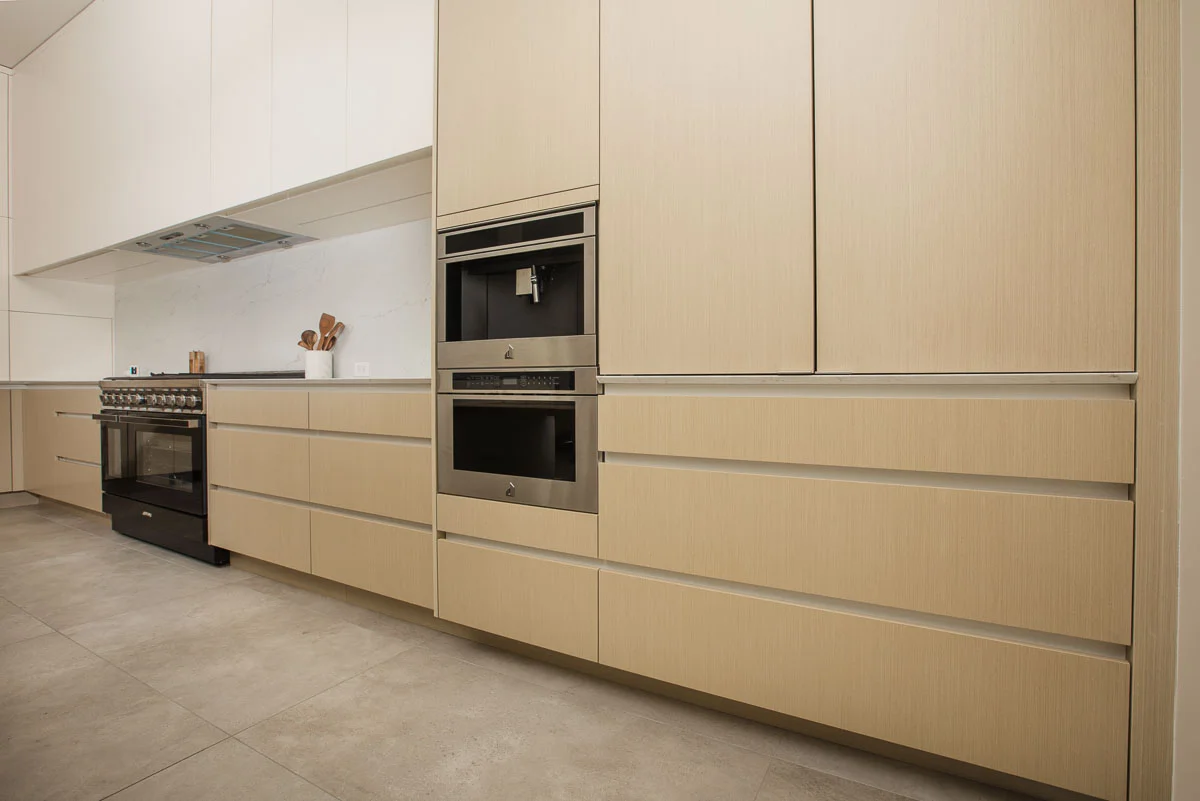
Walk into a truly exceptional kitchen with natural wood cabinetry, and something feels different even before you can articulate why. The grain pattern flows across door fronts as though they were cut from a single, impossibly wide plank. Drawer faces align with the panels above them. The island's wood surface reads as one continuous sweep of figure rather than a patchwork of unrelated boards. This is the result of grain matching, one of the most demanding and rewarding techniques in custom cabinetry, and the hallmark of work produced by a master craftsman.
Grain matching elevates wood cabinetry from well-built to extraordinary. It requires meticulous lumber selection, careful planning at the cutting stage, precise sequencing during assembly, and a deep understanding of how different wood species behave. The process adds time and cost to a project, but for clients who have chosen natural wood as their primary material, it is the single most impactful investment in the finished appearance of their kitchen.
Here is a detailed look at the grain matching techniques we use in our custom kitchen work, from basic book matching to advanced sequential matching across an entire kitchen's worth of cabinetry.
Book Matching: The Foundation of Grain Continuity
Book matching is the most widely known grain matching technique and the starting point for more advanced methods. A board is resawn through its thickness, producing two thinner boards with mirror-image grain patterns. When opened like a book and placed side by side, the grain creates a symmetrical pattern centered on the joint line. This technique is standard for wide door panels, drawer faces, and island end panels where a single board is not wide enough to span the full width.
The quality of a book match depends entirely on the original board. Dramatic figure, whether the cathedral arches of flat-sawn walnut, the ribbon stripe of quarter-sawn sapele, or the burl patterns of maple, creates the most striking mirror effect. Straight, even grain in rift-sawn white oak produces a subtler match that reads as a single wide panel rather than an obvious mirror, which is preferred in contemporary and minimalist kitchen designs where visual calm is the goal.
One technical challenge with book matching is that resawing exposes two different faces of the wood: one that was closer to the bark side and one closer to the heart. These faces can absorb stain and finish slightly differently, creating a phenomenon called "barber pole" effect where alternating panels appear lighter and darker. We mitigate this by careful sanding technique, adjusting the finish schedule for each face, and in some cases specifying slip matching instead where this effect would be unacceptable.
Sequential Matching: Grain Flow Across Multiple Components
Sequential matching takes book matching a step further by maintaining grain continuity across a series of adjacent cabinet doors, drawer fronts, or panels. Imagine a run of four upper cabinets in rift-sawn white oak. Rather than each door being an independent book match, the grain flows from the left edge of the first door through to the right edge of the fourth, as though you sliced a wide plank into four sections and hung them in order.
This technique requires purchasing lumber from a single log or flitch, slicing all the veneer or resawing all the solid stock in sequence, and then carefully mapping each piece to its position in the kitchen. The cabinetmaker numbers every component and tracks its orientation meticulously, because reversing a single panel or placing it out of sequence breaks the visual flow. In our workshop, we lay out the entire sequence on a flat assembly table and photograph it before any joinery begins, creating a reference map that guides the entire build.
Sequential matching is most dramatic in runs of tall pantry doors, banks of upper cabinets at eye level, and kitchen island panels that wrap around three sides. The visual effect is stunning: the wood appears to be a single natural surface interrupted only by the shadow lines of door gaps, rather than a collection of individual cabinet parts. This is one of the details that separates true custom cabinetry from even the best semi-custom options.
Slip Matching, Random Matching, and When to Use Each
Slip matching arranges consecutive veneer sheets or boards side by side without flipping them, so every piece shows the same face. This avoids the barber pole effect that can occur with book matching but produces an asymmetrical pattern where grain lines repeat at regular intervals rather than mirroring. Slip matching creates a more natural, less formal appearance and works particularly well with species that have subtle grain variation, such as cherry, maple, and rift-sawn oak.
Random matching deliberately avoids any systematic grain alignment. Boards or veneer leaves are selected for color consistency but arranged without regard to grain direction or sequence. This creates the most relaxed, organic appearance and is authentic to traditional furniture-making traditions where craftsmen worked with available lumber rather than seeking perfect matches. We recommend random matching for rustic or farmhouse-inspired kitchen designs, particularly when using reclaimed wood or character-grade lumber where knots, mineral streaks, and natural variation are celebrated rather than minimized.
The choice between matching techniques should be driven by the kitchen's design language. A sleek, modern kitchen in figured walnut demands the precision of sequential book matching. A warm, transitional kitchen in quarter-sawn white oak benefits from the quiet continuity of slip matching. A Napa Valley wine country kitchen in reclaimed Douglas fir tells its best story through random matching that highlights the character of each board.
Veneer Matching for Panel Products
Many contemporary kitchen designs use veneered panels rather than solid wood for large flat surfaces like island panels, tall cabinet doors, and integrated appliance panels. Veneer matching follows the same principles as solid wood matching but works with much thinner material, typically 1/42 inch thick, sliced from a log in sequence and applied to a stable substrate like MDF or plywood.
The advantage of veneer for grain matching is that a single flitch can yield hundreds of consecutive leaves, providing enough material to grain-match an entire kitchen from one source. We order full flitches from specialty veneer suppliers and specify the leaf count needed for the project, ensuring continuity from the first panel to the last. The veneer is then pressed onto substrate panels in our workshop, maintaining the exact sequence from flitch to finished component.
For ultra-wide panels, such as a 48-inch-wide island end panel, we use a technique called "center balance matching" where the veneer leaves are arranged symmetrically from the center outward, creating a balanced pattern regardless of the panel width. This prevents the common problem of an odd veneer joint appearing off-center on a wide surface. The finish on veneered panels must be applied with particular care because veneer's thinness makes it more sensitive to sanding and staining inconsistencies.
Species Selection for Optimal Grain Matching Results
Not all wood species are equally suited to grain matching. The best candidates have consistent, predictable grain patterns and accept finishes uniformly. Rift-sawn and quarter-sawn white oak, with its tight, straight grain and medullary ray flecks, is the gold standard for sequential matching in contemporary kitchens. The grain is regular enough that matched panels read as a single surface while still showing natural character.
Walnut offers dramatic figure for book matching, particularly when selected for cathedral or crotch grain that creates bold, expressive mirror patterns. However, walnut's sapwood-to-heartwood color variation requires careful board selection to avoid abrupt color shifts across a matched pair. We steam our walnut lumber to equalize color before resawing, which reduces the contrast between sap and heartwood while maintaining the species' rich chocolate-to-purple tonal range.
For exotic species like zebrawood, wenge, and santos rosewood, grain matching is essential because the dramatic striping and figure in these woods can appear chaotic when arranged randomly but stunningly architectural when matched intentionally. These species also tend to be expensive, making efficient use of material through careful matching both an aesthetic and economic advantage.
Working With Your Cabinetmaker on Grain Matching
Grain matching adds complexity to the design and fabrication process. Lumber must be sourced earlier, often requiring a trip to the mill to select specific logs or flitches in person. Material waste increases because boards must be used in sequence rather than optimized for yield. And the build timeline extends because every cut must be planned in relation to the overall grain map rather than approached independently.
We encourage clients interested in grain matching to discuss it during the initial design consultation so that we can factor the requirements into material procurement, budgeting, and scheduling. We present grain matching options using sample boards cut from the actual lumber selected for the project, allowing you to see exactly how the technique will look in your chosen species and finish. The investment in grain matching is visible every day you use your kitchen, making it one of the most rewarding choices in the entire design process.
Continue exploring kitchen design excellence