Design Insights
Custom Hardware Selection and Installation
Understand custom hardware selection and installation in the creation of premium custom cabinetry.
How Hardware Transforms Custom Cabinetry
The Jewelry of Your Kitchen
Cabinet hardware is the most underestimated element in kitchen design. It is the one thing you physically touch every single time you use your kitchen -- dozens of times a day, thousands of times a year. The weight of a pull in your hand, the way a knob turns, the soft click of a latch closing -- these tactile moments define how your kitchen feels, not just how it looks.
We have seen $200,000 kitchens diminished by $3 pulls from a bargain bin, and $60,000 kitchens elevated to feel twice their budget by thoughtfully chosen hardware. The difference in total cost between cheap hardware and exceptional hardware for a full kitchen is typically $1,500-$4,000 -- a fraction of the overall investment that delivers outsized impact. Here is how to make that investment wisely.
Understanding Hardware Quality Tiers: From Commodity to Heirloom
Not all hardware that looks similar performs similarly. The range in quality is enormous, and the differences reveal themselves over months and years of daily use.
Hardware Quality Tiers
Builder Grade ($2-$8 per piece)
Zinc alloy (zamak) castings with electroplated finish. Brands like Amerock's basic lines, Liberty Hardware, and most Amazon/big-box options. The base metal is porous and soft. The plated finish -- whether "brushed nickel" or "oil-rubbed bronze" -- is typically 2-5 microns thick. These finishes begin showing wear at contact points within 1-3 years: the plating wears through to reveal the gray zinc underneath. Acceptable for rental properties. Inappropriate for custom cabinetry.
Mid-Range ($10-$25 per piece)
Solid zinc or solid brass with better plating (10-15 microns) or PVD (Physical Vapor Deposition) finish. Top Chef, Berenson, Jeffrey Alexander, and Amerock's premium lines fall here. PVD finishes are significantly more durable than electroplating -- they bond at a molecular level and resist scratching, tarnishing, and wear for 5-10 years. This tier represents excellent value for most kitchens.
Premium ($25-$60 per piece)
Solid brass or solid bronze construction with hand-applied patinas or living finishes. Emtek, Schaub, Atlas Homewares, and Rocky Mountain Hardware's standard lines. The weight difference is immediately noticeable -- a solid brass pull feels substantial and confident in your hand. Living finishes (unlacquered brass, oil-rubbed bronze) develop a natural patina over time that many homeowners treasure.
Artisan/Heirloom ($60-$300+ per piece)
Hand-forged or hand-cast pieces from makers like Armac Martin (Birmingham, England), Dauby (Belgium), SA Baxter (New York), Rocky Mountain Hardware's custom lines, and Sun Valley Bronze. Each piece is individually made, often by a single craftsperson. Materials include solid bronze, hand-forged iron, or solid brass with finishes that take days to develop. A full kitchen of Armac Martin hardware runs $5,000-$15,000 -- and it will outlast the cabinets themselves.
Pulls vs. Knobs vs. Integrated: Choosing the Right Hardware Type
The type of hardware you choose affects both the aesthetic and the ergonomics of your kitchen. This is not purely a style decision -- it has real functional implications.
Bar Pulls and Handles
The dominant choice in contemporary and transitional kitchens. Bar pulls are ergonomically superior for drawers because you can wrap four fingers around them and pull with your whole hand, distributing force evenly. For base cabinet drawers (which can be heavy when full), this matters.
Sizing Guidelines:
- - 12-15" wide drawers: 5" to 6" pull (center-to-center measurement)
- - 18-24" wide drawers: 6" to 8" pull
- - 30-36" wide drawers: 10" to 12" pull, or two smaller pulls spaced evenly
- - Upper cabinet doors: 5" to 8" pull, mounted vertically on the stile closest to the opening edge
- - Base cabinet doors: 5" to 6" pull, mounted horizontally near the top edge, or vertically for consistency
Knobs
Traditional, classic, and space-efficient. Knobs work beautifully on cabinet doors where you are simply pulling the door open against a hinge. They are less ideal for heavy drawers because you can only grip with two or three fingers, concentrating force on a small area.
The Mix-and-Match Approach (Our Recommendation):
- - Knobs on all upper and lower cabinet doors
- - Pulls on all drawers (for ergonomic grip)
- - Match the finish and design family so they complement without being identical
- - This is the most functional and visually balanced approach in traditional and transitional kitchens
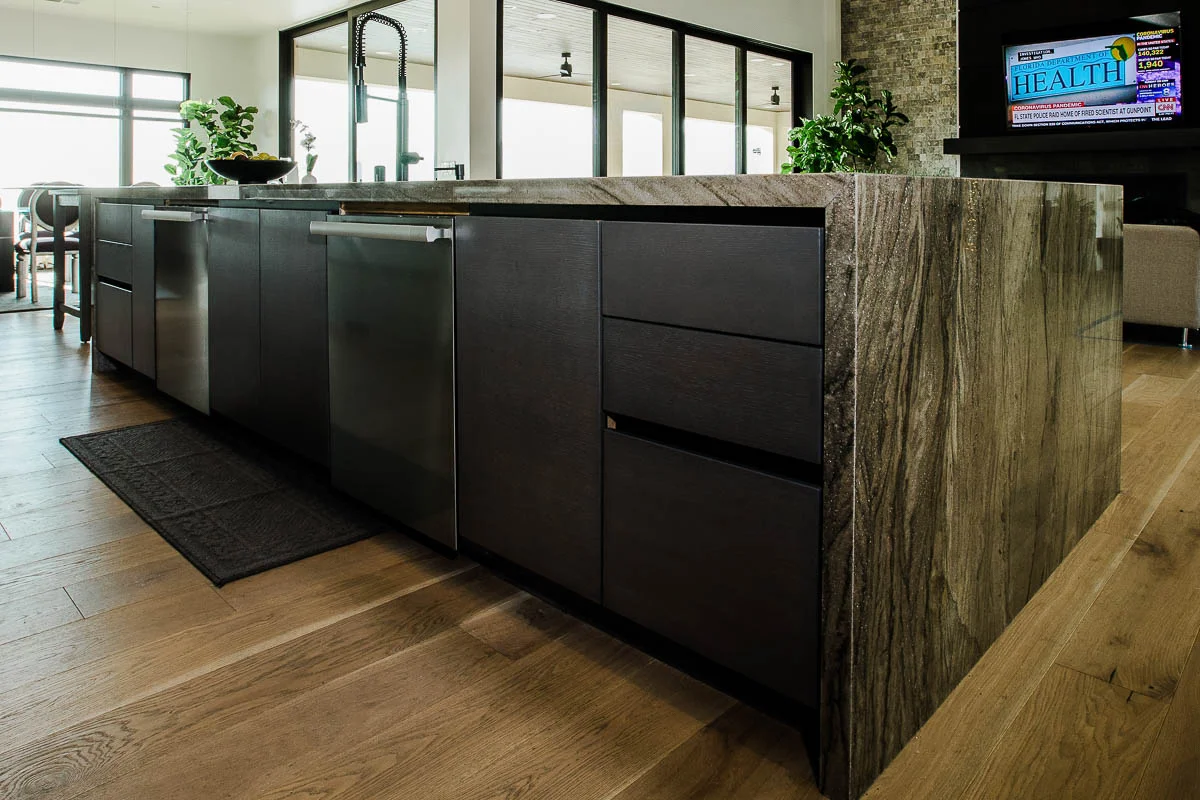
Integrated Pulls and Handle-Free Design
For ultra-modern and minimalist kitchens, hardware can be eliminated entirely. Options include J-channel pulls (a routed groove along the top or bottom edge of doors and drawers), push-to-open mechanisms (Blum TIP-ON or Servo-Drive), and recessed finger pulls carved directly into the door edge.
Important Considerations:
- - Push-to-open mechanisms add $15-$30 per door/drawer in hardware cost
- - J-channel routing must be done in the shop -- it cannot be added later
- - Fingerprints are more visible on handle-free cabinetry (especially on painted or lacquered surfaces)
- - Servo-Drive (electronic) push-to-open is smoother than mechanical TIP-ON but requires electrical connections
- - Handle-free design works best with true custom cabinetry where tolerances are tight enough for consistent operation
Finish Selection: Matching Hardware to Your Kitchen's Material Palette
Hardware finish is one of the most powerful tools for tying a kitchen's disparate elements together. The faucet, light fixtures, range hood, appliance handles, and cabinet hardware should speak the same metallic language -- though they do not need to match exactly.
Popular Finish Pairings for California Kitchens
Unlacquered Brass + White Oak Cabinetry
The warm golden tone of raw brass (which will develop a rich patina over 6-12 months) pairs beautifully with the honey-amber tones of white oak. This combination dominates California's high-end coastal and modern farmhouse projects. Pair with Rohl or Waterstone unlacquered brass faucets and Schoolhouse Electric or Cedar & Moss brass light fixtures for a cohesive material story.
Satin Nickel + Painted Cabinetry (White, Sage, Navy)
Satin nickel's cool, muted silver tone complements nearly any paint color without competing for attention. It is the most versatile finish -- forgiving of fingerprints, consistent across manufacturers, and timeless. Pair with Brizo or Kohler satin nickel faucets. This is the safe but sophisticated choice that never goes out of style.
Matte Black + Walnut or Dark-Stained Cabinetry
Matte black hardware creates bold graphic lines against dark wood, emphasizing the cabinetry's geometry. This pairing suits modern and industrial-leaning kitchens. Be cautious: matte black finishes from different manufacturers can vary noticeably -- some lean warm (brownish), others cool (bluish). Always compare samples side by side before committing.
Oil-Rubbed Bronze + Traditional or Craftsman Cabinetry
The deep brown-black of oil-rubbed bronze, often with highlights showing through at edges, suits traditional raised-panel and Craftsman-style inset cabinetry. It coordinates well with period architectural details. Note: "oil-rubbed bronze" varies wildly between manufacturers. Emtek's ORB is quite dark, while Schaub's has more visible warm highlights. Sample before committing.
Hinge and Slide Selection: The Hardware You Do Not See
The hidden hardware -- hinges, drawer slides, and lift mechanisms -- is arguably more important than the visible pulls and knobs. It determines how your kitchen feels and functions every time you open a door or drawer. Skimping here is the biggest hidden mistake in kitchen design.
Cabinet Hinges: Blum vs. Grass vs. Hettich
The three dominant European hinge manufacturers each have strengths. Blum Clip Top BLUMOTION is the industry standard for luxury cabinetry -- smooth, reliable, with integrated soft-close and tool-free adjustment. Grass Tiomos offers a slightly different feel (some prefer its soft-close action) and tool-free snap mounting. Hettich Sensys is excellent and often more cost-effective. All three are dramatically superior to generic hinges and are rated for 200,000+ opening cycles.
For Inset Cabinetry (Doors Flush With Frame):
- - Inset hinges require tighter tolerances and more precise installation
- - Blum Clip Top BLUMOTION Inset is the gold standard -- 3-way adjustment compensates for seasonal wood movement
- - Expect a $50-$80 premium per door for inset hinge hardware versus overlay
- - Seasonal humidity changes in California can cause inset doors to bind or gap slightly -- quality hinges with adjustment range prevent this from becoming a problem
Drawer Slides: Where You Should Never Compromise
A quality drawer slide transforms the experience of using your kitchen. The difference between a Blum Tandembox and a basic ball-bearing slide is the difference between closing a Mercedes door and closing a rental car door. Both work, but one feels like precision engineering.
Our Standard Specifications:
- - Standard drawers: Blum Tandembox Antaro (88-lb rating, integrated soft-close, full extension)
- - Heavy-duty drawers (pots, pans, dishes): Blum LEGRABOX (155-lb rating, same smooth action at heavy loads)
- - Deep pan drawers: Blum Tandembox with 770M height extension, allowing drawer walls up to 8" for deep storage
- - Waste/recycling pullouts: Blum Tandem with BLUMOTION, paired with Rev-A-Shelf 4WCSC series bins
- - Never: Epoxy-coated steel slides, side-mount ball-bearing slides, or any slide rated under 75 lbs in a kitchen application
Lift Systems for Upper Cabinets
Traditional upper cabinet doors swing outward and can block adjacent cabinets or hit pendant lights. Modern lift mechanisms solve this elegantly. Blum Aventos HF (bi-fold lift) splits the door horizontally so it folds up and out of the way. Aventos HL (parallel lift) raises the entire door straight up. Aventos HK-XS is a compact stay-lift for smaller cabinets. These systems are particularly valuable above appliance garages and in tall pantry applications where a full-height door would be impractical.
Installation Precision: Why Placement Matters More Than You Think
Even the finest hardware looks wrong if installed inconsistently. Placement tolerances in luxury cabinetry should be within 1/32 of an inch -- every pull at exactly the same height, every knob at exactly the same position relative to the door edge. This requires a systematic approach.
Professional Installation Standards
Jig-Based Drilling
Every hole is drilled using a calibrated hardware jig (True Position TP-1935 or equivalent) that ensures identical placement on every door and drawer. Handheld drilling with a tape measure is never acceptable for custom work. One misplaced hole means replacing the entire door -- there is no fixing a hole in a finished cabinet face.
Standard Placement Conventions
Base cabinet pulls: centered horizontally on the stile, 2.5"-3.5" from the top edge of the door. Upper cabinet pulls: centered horizontally on the stile, 2.5"-3.5" from the bottom edge. Drawer pulls: centered both horizontally and vertically on the drawer face. These positions are adjusted based on door size and overall kitchen proportions -- our designers specify exact placement for each project.
Screw Length and Backing
Hardware screws must be the correct length to engage fully without penetrating through the door or drawer face. For painted MDF doors (typically 3/4" thick), we use #8-32 machine screws in 1" length. For solid wood, slightly longer screws with thread-locking compound prevent loosening over time. Heavy pulls on upper cabinets benefit from a backing plate or washer on the interior side to distribute the load and prevent the screw from pulling through under repeated use.
Hardware is the final touch that brings a custom kitchen to life. It is the handshake between you and the space -- the first physical interaction you have every morning and the last one every night. Investing thoughtfully in hardware selection and insisting on precise installation ensures that your kitchen not only looks exceptional but feels exceptional in a way that no photograph can capture. For guidance on maintaining your hardware and cabinetry finishes long-term, see our daily maintenance tips for custom cabinetry, and explore color psychology in luxury kitchen design to understand how hardware finishes influence the emotional tone of your space.
Continue exploring kitchen design excellence
Related Articles
Custom vs. Stock Cabinets
Understanding the real differences in construction, materials, and value
Read More →Appliance Garage Design
Integrate lift mechanisms and custom storage into your countertop zones
Read More →Architectural Integration
How cabinetry hardware ties into your home's broader architectural language
Read More →