Design Insights
Design Challenge: Small Space, Big Impact
Real-world examples of design challenge: small space, big impact in custom kitchen projects.
How Custom Cabinetry Transforms Compact California Kitchens
Luxury Is Not About Square Footage
Some of the most rewarding projects we undertake at PineWood Cabinets are compact kitchens where every inch must earn its place. In San Francisco, where a three-bedroom Victorian might have a kitchen under 100 square feet, or in a beachfront condo in Santa Monica where the kitchen shares an open floor plan with the living area, the design challenge is not how much you can fit in, but how to make what fits feel intentional, beautiful, and deeply functional.
The misconception that luxury requires large spaces is one we challenge regularly. A 90-square-foot kitchen built with rift-cut white oak, fitted with Blum Legrabox drawers, and topped with honed Calacatta marble can deliver a more refined experience than a 400-square-foot kitchen filled with stock cabinetry. The key lies in custom solutions that are designed precisely for the space, rather than adapted from standard sizes that leave gaps, dead corners, and wasted volume.
In this article, we share strategies drawn from real projects where we turned spatial constraints into design opportunities. These are the techniques that make small kitchens not just livable, but genuinely impressive.
Maximizing Vertical Space
In compact kitchens, the walls are your most valuable asset. Standard upper cabinets typically stop 12 to 18 inches below the ceiling, leaving dead space that collects dust and looks unfinished. In a small kitchen, we always run cabinets to the ceiling. This adds 30 to 40 percent more storage volume and creates a built-in, architectural quality that makes the room feel taller and more intentional.
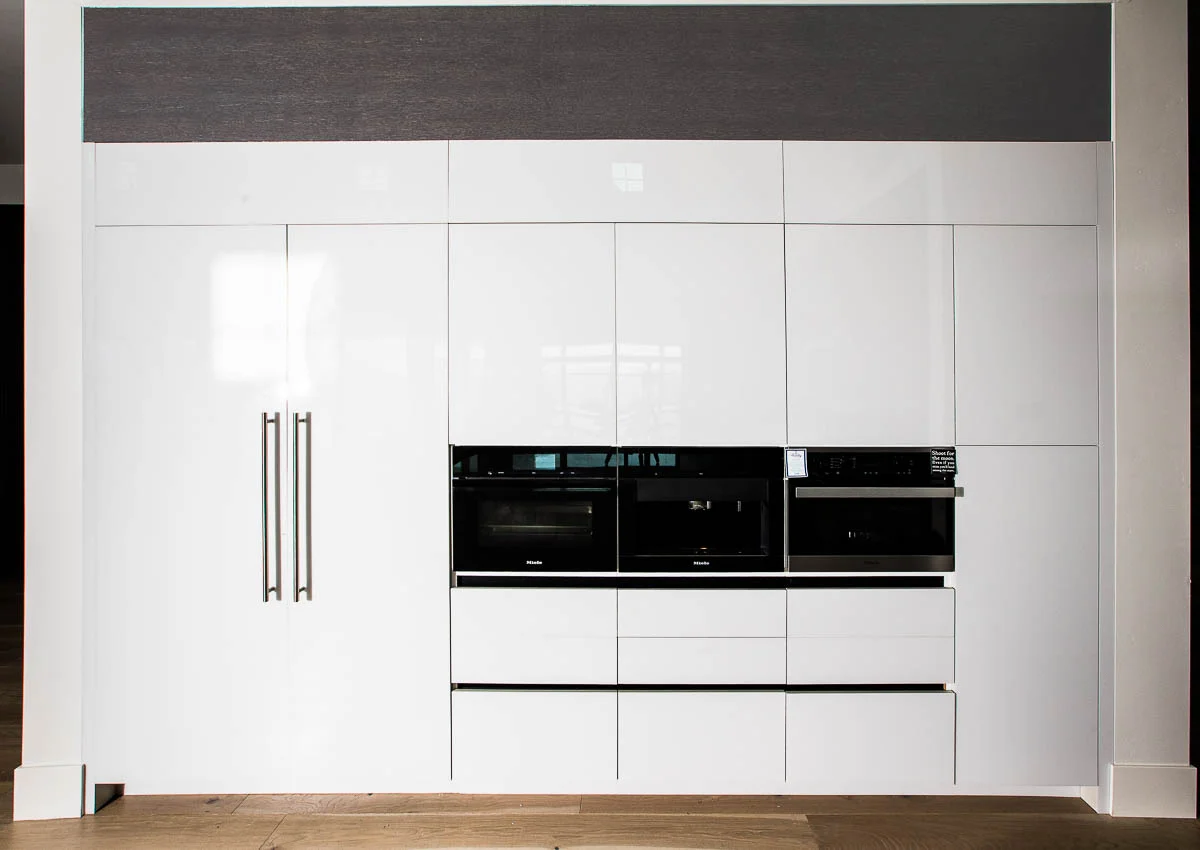
For ceilings at 9 or 10 feet, we use a two-tier approach: standard-depth uppers at eye level for daily items and shallower cabinets above for seasonal or rarely used pieces. The upper tier can be accessed with a simple library ladder, a brass rail mounted along the soffit, or just a sturdy step stool stored in the toe-kick pull-out. In a recent Nob Hill project, we installed floor-to-ceiling cabinetry along one full wall, creating what the client calls their "everything wall" because it holds pantry items, a built-in microwave, a coffee station, and a broom closet, all behind flush panel doors that read as a single, clean surface.
Custom-Sized Cabinetry: No Dead Space
Stock and semi-custom cabinets come in fixed increments, typically 3-inch width steps. In a small kitchen, those increments add up to inches of wasted space at the end of every run. Custom cabinetry eliminates this problem entirely. If your wall measures 87 and three-quarter inches, your cabinets span exactly 87 and three-quarter inches. No fillers. No gaps. No wasted space.
This precision extends to depth as well. Standard base cabinets are 24 inches deep, but in a narrow galley kitchen where the aisle needs to be wider, we can build base cabinets at 21 or 22 inches deep. The two or three inches gained on each side translates to four to six inches of additional aisle width, which is the difference between feeling cramped and feeling comfortable. Upper cabinets can similarly be reduced from 12 inches to 10 inches deep without sacrificing meaningful storage capacity for plates and glasses.
Corner solutions are where custom really shines in small spaces. Stock lazy Susans waste roughly 30 percent of the available corner volume. Our custom corner solutions, including full-extension bi-fold trays and butterfly shelving systems from Hafele, recover that volume and make every item accessible without reaching blindly into the back of a dark cabinet. Our custom kitchen team designs these solutions specifically for each corner geometry.
Optical Illusions That Work
Strategic design choices can make a small kitchen feel significantly larger than its actual dimensions. Continuous grain matching, where the wood grain flows seamlessly from one cabinet door to the next, eliminates visual interruptions and makes a run of cabinets read as a single, expansive surface. This technique requires extra care during fabrication, laying out veneer sheets sequentially and assigning them to specific door positions, but the result is striking.
Light-colored woods and finishes expand the perceived space. White oak with a clear matte finish, or painted cabinets in soft whites and warm grays, reflect light rather than absorbing it. Integrated LED lighting under upper cabinets and inside glass-front display cabinets adds layers of illumination that push the walls outward visually. We particularly recommend lighting the interior of at least two or three upper cabinets with glass doors to create depth.
Handleless cabinet designs using push-to-open mechanisms or integrated J-pull profiles eliminate the visual clutter of hardware. In a large kitchen, decorative pulls and knobs add character. In a small kitchen, they create visual noise that makes the space feel busy. A clean, handle-free surface in a continuous material lets the eye travel uninterrupted from one end of the kitchen to the other, creating a sense of calm and spaciousness.
Multi-Functional Elements
In small kitchens, every element should serve at least two purposes. A butcher block island on locking casters serves as a prep surface, a dining table for two, and additional storage. When not needed, it rolls against the wall or into an adjacent room. A fold-down shelf on the wall becomes a workspace when extended and disappears when folded flat, freeing up floor area.
We have designed cutting boards that fit precisely over sink basins, creating temporary prep space exactly where water access is needed. Pull-out work surfaces hidden within base cabinets provide extra counter area when cooking and tuck away when you need the clearance. In one Sausalito project, we built a 12-inch-deep pull-out table that slides from the end of a cabinet run, seats two for breakfast, and is completely invisible when stored.
Appliance integration is especially critical in compact spaces. Panel-ready refrigerators, dishwashers, and even range hoods that blend into the cabinetry create a unified surface that makes the kitchen feel like a cohesive piece of furniture rather than a collection of mismatched equipment. Under-counter appliances, including microwave drawers and single-drawer dishwashers from Fisher and Paykel, free up counter and wall space that conventional appliances would consume.
Storage Solutions for Compact Spaces
The most impactful storage upgrades in small kitchens are those that use otherwise dead space. Toe-kick drawers beneath base cabinets provide a hidden layer of storage for flat items like baking sheets, cutting boards, and table linens. The 4-inch space between the cabinet bottom and the floor, normally wasted behind a simple kick plate, becomes a functional drawer with a touch- latch opening mechanism.
Narrow pull-outs, sometimes just three inches wide, fit between the refrigerator and the wall or between the range and a cabinet. These slender units hold spices, oils, or canned goods in a single accessible column. We use Blum Tandembox drawer systems for these pull-outs because their precision engineering ensures smooth, quiet operation even in narrow configurations where other hardware would bind.
Inside cabinets, vertical dividers for baking sheets and cutting boards, two-tier pull-out shelves, and door-mounted racks for spices and wraps multiply the usable capacity. A well-organized custom storage system in a small kitchen can hold as much as a disorganized kitchen twice its size. The difference is that everything has a designated place and every item is accessible without moving five other things first.
Material Choices That Enhance Small Spaces
Material selection matters more in compact kitchens because you see and touch the surfaces more intensely. We recommend investing in the best materials your budget allows, since the total material quantity is smaller and the cost difference between standard and premium is proportionally less impactful. A full slab backsplash in Calacatta marble might cost $3,000 in a small kitchen compared to $12,000 in a large one, but the visual impact is equally powerful.
Reflective materials, including polished stone, high-gloss lacquer, and glass-front cabinets, bounce light around the room and enhance the feeling of openness. However, glossy surfaces show fingerprints and imperfections more readily, so they require more frequent cleaning. A matte or satin finish on wood cabinetry paired with a polished stone countertop offers the best balance of luminosity and practicality. Browse our materials collection to explore options that work beautifully in compact spaces.
Continue exploring kitchen design excellence
Related Articles
Hidden Storage Solutions for Modern Kitchens
Discover innovative storage that maximizes every cubic inch
Read More →Ergonomic Kitchen Design for Comfort
How ergonomic principles make compact kitchens more functional
Read More →