Design Insights
Ergonomic Kitchen Design for Comfort
Learn about ergonomic kitchen design for comfort for maximizing kitchen efficiency and organization.
How Ergonomic Principles Eliminate Strain and Enhance the Cooking Experience
A Kitchen That Fits Your Body
The standard kitchen dimensions used across the industry were established decades ago based on average body measurements that no longer reflect reality. A standard 36-inch counter height was designed for a person roughly five foot four. Standard upper cabinets mounted at 54 inches above the floor assume a reach height that works for some people and causes shoulder strain for others. In a custom kitchen, there is no reason to accept these one-size-fits-all dimensions when the cabinetry can be built to fit the people who actually use the space.
Ergonomic kitchen design is about reducing physical strain, minimizing unnecessary movement, and placing frequently used items within natural reach zones. A well-designed ergonomic kitchen is not noticeably different from a conventional kitchen at first glance. The differences are subtle, measured in inches, and felt in comfort: less bending, less reaching, less walking, and less fatigue after preparing a complex meal.
At PineWood Cabinets, we incorporate ergonomic principles into every project as part of our design process. Some adjustments are simple and cost- free. Others require thoughtful planning and custom fabrication. All of them make a measurable difference in how the kitchen feels to use every day.
Counter Height: The Foundation of Comfort
The standard 36-inch counter height is a reasonable starting point for most adults, but it is not optimal for everyone. The ideal counter height for food preparation, where you press down on a cutting board or roll dough, places your elbow at a 45-degree angle with your forearm parallel to the work surface. For a person five foot ten, this is approximately 38 inches. For someone five foot two, it is closer to 34 inches.
In a custom kitchen, we can vary counter heights by zone. The primary prep area can be set at the ideal height for the person who cooks most frequently, while a baking station can be set two inches lower to provide better leverage for kneading and rolling. The sink area can be raised slightly because the bottom of the sink basin sits four to six inches below the countertop, placing your hands lower than the surface height suggests.
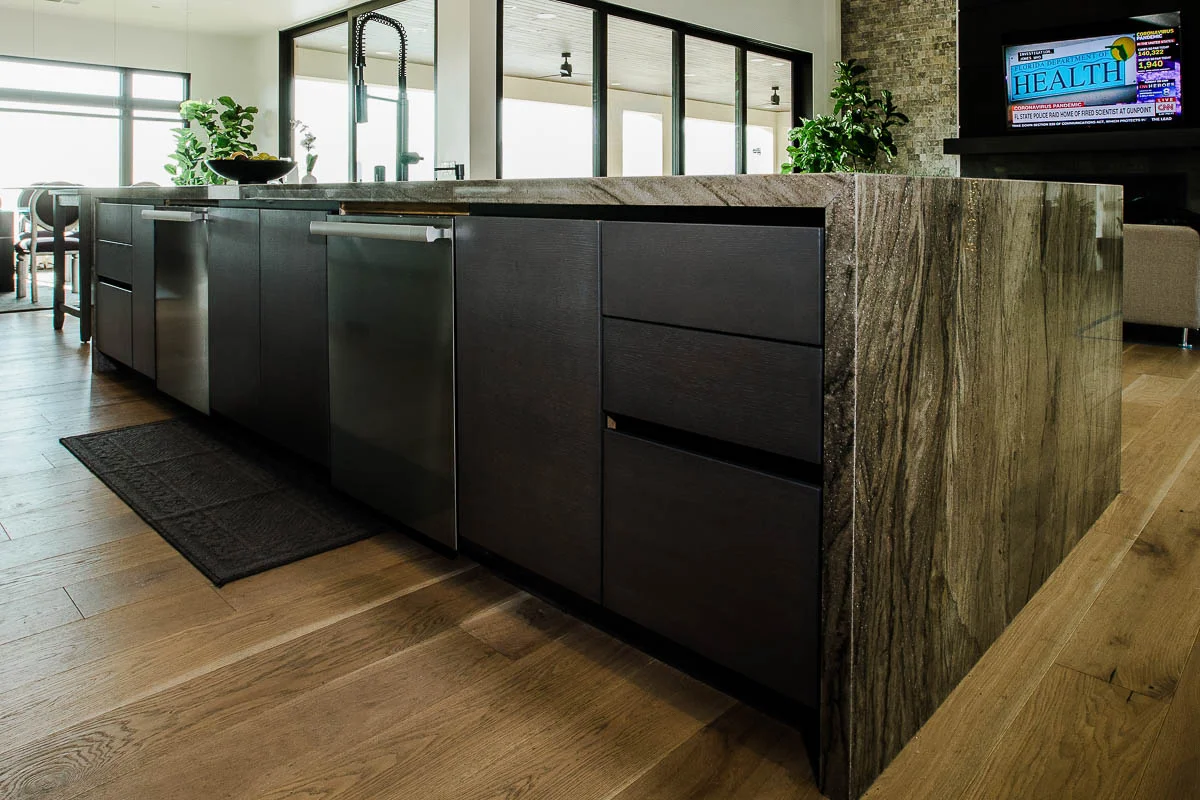
Island heights can differ from perimeter counter heights without looking unusual, and the seating side of an island is always at a different height than the work side. We have built kitchens with three distinct counter heights: a 34-inch baking station, a 36-inch general prep zone, and a 42-inch bar height for the island seating. The transitions are handled with elegant waterfall edges or subtle step-downs that look intentional and sophisticated.
The Work Triangle and Beyond
The traditional kitchen work triangle, connecting the sink, stove, and refrigerator, was developed in the 1940s and remains a useful starting framework. The principle is that the three most-used stations should form a triangle with legs between 4 and 9 feet, minimizing walking distance between tasks. However, modern luxury kitchens with islands, multiple sinks, and specialized zones have outgrown the simple triangle model.
We use a zone-based approach that maps the flow of typical meal preparation sequences. Groceries arrive and are stored (the landing and pantry zone). Ingredients are retrieved and prepped (the refrigerator and prep zone). Food is cooked (the cooking zone). Dishes are washed and stored (the cleaning and storage zone). Each zone should have its own dedicated counter space, storage for zone-specific items, and clear paths to adjacent zones without crossing other traffic areas.
The distances between zones should reflect their frequency of interaction. The prep zone and cooking zone are used in rapid alternation, so they should be adjacent with no obstacles between them. The refrigerator and prep zone likewise need to be close, ideally within two steps. The cleaning zone can be slightly more separated since dishwashing usually happens after the active cooking phase. Our custom kitchen layouts are designed around these workflow patterns.
Reach Zones and Cabinet Placement
Ergonomic research identifies three reach zones. The primary zone extends from waist height to shoulder height, roughly 28 to 60 inches off the floor for an average adult. Items used daily should be stored in this zone: plates, glasses, frequently used pots, cooking utensils, spices, and staple ingredients. The secondary zone includes areas accessible with a slight bend or stretch, from 15 to 28 inches and 60 to 72 inches. Seasonal items, specialty tools, and less-used appliances belong here. The tertiary zone, below 15 inches and above 72 inches, should hold only rarely accessed items.
Custom cabinetry allows precise implementation of these zones. We design deep base drawers rather than shelved base cabinets because drawers bring contents to you rather than requiring you to bend and reach into dark recesses. Full- extension Blum Tandembox slides ensure that even items at the very back of a drawer are visible and accessible. For upper cabinets, we can lower the mounting height by two inches for shorter users or install pull-down shelving systems from Hafele or Rev-A-Shelf that bring upper shelf contents within easy reach.
Wall ovens mounted at the right height are a significant ergonomic improvement over floor-level ranges. The oven opening should be at or slightly below elbow height so you can slide heavy roasting pans in and out without bending or lifting awkwardly. For most adults, this means mounting the oven so the rack is at approximately 30 to 34 inches off the floor. Microwave drawers installed at counter height are similarly easier on the body than overhead mounted microwaves that require lifting hot dishes above shoulder level.
Flooring and Anti-Fatigue Solutions
Prolonged standing on hard surfaces causes leg fatigue, back pain, and joint stress. This is an often-overlooked ergonomic factor in kitchen design. Hardwood flooring is more forgiving than stone or tile, and engineered hardwood with a cushioned underlayment provides additional comfort. Cork flooring offers natural resilience and warmth underfoot but requires careful sealing in kitchen environments where water exposure is frequent.
For stone or tile floors, we recommend anti-fatigue mats in the primary standing zones: in front of the sink, the stove, and the main prep counter. High-quality anti-fatigue mats from GelPro or Imprint are available in colors and patterns that complement luxury kitchen aesthetics. For a seamless approach, recessed mat wells can be built into the flooring so the mat sits flush with the surrounding surface, eliminating the tripping hazard and visual disruption of a mat sitting on top of the floor.
Lighting for Reduced Eye Strain
Inadequate lighting forces you to lean forward and squint, creating neck strain and poor posture. The most common lighting mistake in kitchens is relying solely on overhead recessed fixtures, which cast shadows across the work surface when you stand between the light and the counter. Under-cabinet task lighting solves this by placing the light source in front of you, directly above the work area, eliminating shadows entirely.
We specify LED under-cabinet lighting with a color temperature between 3000K and 3500K and a color rendering index above 90. This produces warm, accurate light that renders food colors naturally and is comfortable for extended use. The light level at the countertop should be 50 to 75 foot-candles for food preparation tasks. Dimming capability allows you to reduce brightness for casual use and increase it when precise knife work or reading recipes requires full illumination.
Designing for Aging in Place
Many of our California clients are designing kitchens they plan to use for decades. Incorporating universal design principles now avoids expensive retrofits later. Wider aisles of 48 inches accommodate mobility aids. Lever- style faucet handles are easier to operate than knobs for anyone with arthritis or grip limitations. Pull-out step stools hidden in the toe-kick of base cabinets provide safe access to upper shelves as reaching becomes harder. D-shaped cabinet pulls are easier to grasp than round knobs.
Touch-activated faucets and Blum Servo-Drive electrical opening systems for drawers and doors allow hands-free operation, a convenience now that becomes essential later. Choosing these features at the design stage costs a fraction of retrofitting them after the kitchen is built. Our custom kitchen team can integrate aging-in-place features that are invisible in the design but transformative in daily life as needs change over time.
Continue exploring kitchen design excellence
Related Articles
Design Challenge: Small Space, Big Impact
How ergonomics matter even more in compact kitchens
Read More →