Design Insights
IoT Integration in Modern Kitchens
Explore iot integration in modern kitchens in modern luxury kitchen design and functionality.
How IoT Is Transforming Luxury Kitchen Design in California
The Connected Kitchen
The Internet of Things has moved well beyond novelty gadgets and voice-activated speakers. In the luxury kitchens we design across California—from Silicon Valley smart homes to Beverly Hills estates—IoT integration has become a fundamental design consideration that shapes everything from cabinetry layout to electrical planning. Today's connected kitchen is a seamlessly orchestrated environment where appliances communicate, lighting adapts to your routine, and inventory management happens automatically.
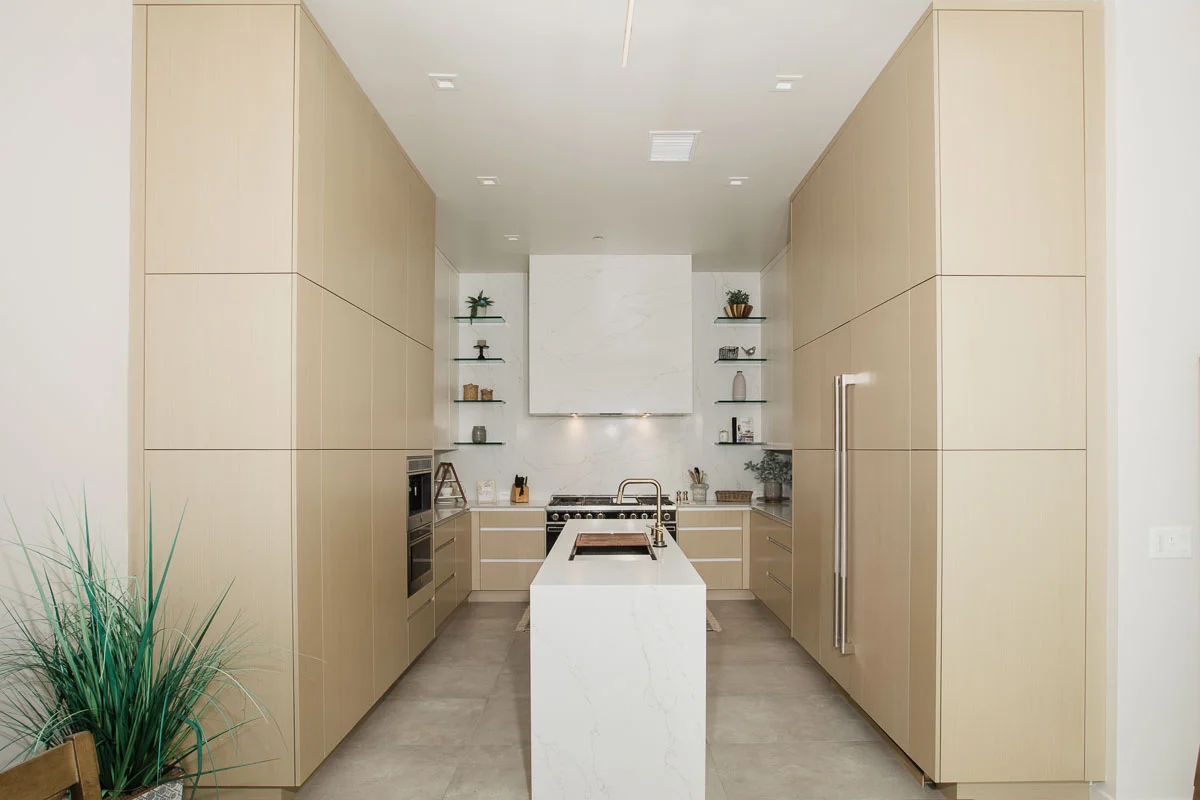
What makes IoT integration particularly compelling in custom kitchen design is that it must be invisible. Our clients in Atherton and Palo Alto are technology leaders who demand cutting-edge functionality, but they also want kitchens that feel warm and inviting—not like a spaceship cockpit. The challenge, and our specialty, lies in embedding sophisticated technology within beautiful cabinetry so that the kitchen looks timeless even as its capabilities are decidedly futuristic.
Successful IoT kitchen integration requires planning from day one of the design process. Retrofitting connected systems into an existing kitchen is possible but never as elegant as building them in from the start. Here is what we have learned designing hundreds of smart kitchens across the state.
Key IoT Integration Areas for Luxury Kitchens
Smart Appliance Ecosystems
Connected ovens, refrigerators, dishwashers, and hoods that coordinate operations automatically
Intelligent Lighting Control
Tunable-white LED systems that adapt color temperature and intensity throughout the day
Automated Storage Systems
Motorized cabinet doors, descending shelves, and servo-driven access mechanisms
Water Management
Leak detection, smart faucets, and automated shut-off systems protecting your investment
Voice and Hub Control
Centralized control through voice assistants, wall panels, and concealed tablet stations
Future-Proofing Infrastructure
Conduit runs, extra circuits, and modular mounting for technology that has not been invented yet
Smart Appliance Ecosystems
The backbone of any IoT kitchen is the appliance suite. Brands like Thermador Home Connect, Miele@home, and Sub-Zero/Wolf Connected have developed robust ecosystems where ovens, refrigerators, dishwashers, and ventilation hoods share data and coordinate operations. A Miele oven can automatically activate the hood when it detects high heat, while a Sub-Zero refrigerator can send alerts when its water filter needs replacement or when the door has been left ajar.
From a cabinetry perspective, smart appliances influence our designs significantly. We need to plan for Wi-Fi signal paths—avoiding solid metal panels that block connectivity—and ensure adequate ventilation for electronics that generate additional heat. We also design dedicated charging stations and USB-C outlets into our cabinetry, hidden behind flip-up panels or within drawer interiors, so devices stay powered without cluttering countertops.
One recent project in Menlo Park featured a Gaggenau induction cooktop paired with a connected hood system that communicates via Bluetooth. The hood adjusts its fan speed automatically based on cooking intensity. We designed a custom ceiling soffit to house the ventilation unit while concealing all wiring, and built motorized cabinet panels that open to reveal a central control tablet when needed and close flush when not in use.
Top Connected Appliance Brands We Specify
- • Thermador Home Connect: Full ecosystem integration across cooking, refrigeration, and dishwashing
- • Miele@home: Remote monitoring, automatic program downloads, and cross-appliance coordination
- • Sub-Zero/Wolf Connected: Smart diagnostics, filter monitoring, and performance optimization
- • Gaggenau: Bluetooth-connected hoods and ovens with automated ventilation response
- • BSH Home Connect Platform: Unified control for Bosch, Thermador, and Gaggenau appliances
Intelligent Lighting Control
Lighting is where IoT integration delivers perhaps the most transformative daily experience. Modern systems from Lutron Ketra, Savant, and Crestron allow us to program lighting scenes that adjust color temperature and intensity throughout the day. In the morning, under-cabinet LEDs come on at a warm 2700K to ease you into the day. During meal prep, task lighting shifts to a bright, neutral 4000K for accurate color rendering. At dinner, the kitchen dims to a warm glow that flatters food and faces alike.
We integrate LED strips directly into our cabinetry—inside glass-front display cabinets, beneath upper cabinets, along toe kicks, and inside deep drawers. Each zone is independently addressable. A Lutron RadioRA 3 system, for example, can control dozens of individual lighting zones from a single app, wall keypad, or voice command. We work closely with lighting designers to ensure every fixture is pre-wired during the cabinetry installation phase, eliminating visible wiring entirely.
Occupancy and daylight sensors add another layer of intelligence. Cabinets with interior lighting that activates when doors open, pantry lights triggered by motion, and ambient lighting that adjusts based on natural light levels from windows—all of these create a kitchen that feels intuitively responsive without requiring any conscious interaction. Learn more about our approach to LED lighting systems in custom kitchens.
Lighting Scene Programming Examples
Automated Storage and Access Systems
IoT-enabled motorized cabinetry is one of the most exciting frontiers in kitchen design. Servo-driven cabinet doors that open with a light touch or voice command, motorized shelving that descends from upper cabinets to counter height, and automated pantry systems that rotate shelves to present the items you need—these are no longer science fiction.
We frequently install Blum AVENTOS lift systems with electronic Servo-Drive for upper cabinet doors, allowing them to open and close at the touch of a button or via integration with home automation systems like Control4 or Savant. For clients with accessibility needs or anyone who simply appreciates convenience, motorized base cabinet pull-outs from Kesseböhmer's iMove system bring contents forward and up, eliminating the need to bend or reach into deep cabinets.
The cabinetry for these systems requires precise engineering. Motorized components need reinforced boxes, specific clearance dimensions, and dedicated low-voltage wiring run during the rough-in phase. We design custom mounting solutions using Baltic birch plywood and steel reinforcement plates to ensure these mechanisms operate flawlessly for decades. Our custom kitchen service includes full integration planning for all automated systems.
Motorized Cabinetry Systems We Install
- • Blum AVENTOS with Servo-Drive: Electric lift systems for upper cabinet doors—open and close with a touch or voice command
- • Kesseböhmer iMove: Motorized pull-down shelving that brings upper-cabinet contents to counter height
- • Blum SERVO-DRIVE for drawers: Touch-activated drawer opening for handleless designs
- • Custom motorized pocket doors: Concealed small-appliance garages that open and close electronically
- • Motorized pop-up tablet stations: Control panels that rise from countertops on demand
All motorized systems are built on reinforced Baltic birch plywood frames with steel mounting plates for decades of reliable operation.
Water Management and Leak Detection
Smart water systems are an often-overlooked aspect of IoT kitchen integration, yet they protect what is typically a six-figure investment in custom cabinetry and finishes. Devices like Flo by Moen and Phyn Plus monitor water usage patterns, detect leaks instantly, and can automatically shut off the water supply before damage occurs. For luxury kitchens with exotic wood cabinetry and natural stone, this protection is invaluable.
We install moisture sensors inside sink base cabinets, beneath dishwashers, and near refrigerator water lines—all hardwired during the build phase so they are invisible and maintenance-free. These sensors connect to the home's smart hub and send alerts to your phone at the first sign of moisture. In a recent Los Altos Hills project, we integrated Grohe Blue and Red faucet systems that deliver filtered, chilled, sparkling, or boiling water on demand, all controlled via an app that tracks filter life and water consumption.
Voice Control and Central Hubs
Voice assistants—whether through Amazon Alexa, Google Home, or Apple HomeKit—have become the primary interface for controlling IoT kitchen systems. The key design challenge is speaker and microphone placement. We build dedicated recessed housing for smart speakers within cabinetry, positioned to optimize voice pickup while remaining acoustically unobstructed. A speaker hidden behind a perforated metal grille in an upper cabinet panel, for instance, delivers clear audio while maintaining the kitchen's clean aesthetic.
For clients who prefer visual control, we design pop-up or flush-mounted tablet stations within the cabinetry. A 10-inch iPad or dedicated Crestron touch panel integrated into an end panel or backsplash area serves as the kitchen's command center—controlling lighting, appliances, music, and even pulling up recipes. We use motorized mechanisms so the screen rises when summoned and disappears when not needed, keeping the kitchen's visual design uninterrupted.
The most sophisticated installations we have done in the Bay Area use a unified platform like Savant or Crestron that ties every system together. One "Good Morning" voice command can turn on under-cabinet lighting, start the coffee maker, raise the kitchen window shades, and tune the built-in speakers to your preferred morning playlist—all without touching a single switch.
Control Platform Comparison
Entry Level: Apple HomeKit / Google Home / Amazon Alexa
Good for individual device control. Limited scene programming. Best for clients who want basic voice control without dedicated hardware.
Mid-Level: Lutron RadioRA 3 + Smart Speakers
Excellent lighting control with reliable scene programming. Integrates with voice platforms. Our most-recommended setup for most projects.
Premium: Savant or Crestron Whole-Home
Unified control of all systems—lighting, AV, HVAC, shades, security. Custom programming. Dedicated touch panels. For clients who want everything connected seamlessly.
Future-Proofing Your Connected Kitchen
Technology evolves rapidly, and a kitchen built today should be ready for innovations that do not yet exist. Our approach to future-proofing involves three strategies. First, we run conduit—not just wire—through cabinet runs and walls, so new cables or fiber can be pulled through later without opening walls. Second, we install more electrical circuits and outlets than currently needed, including dedicated 20-amp circuits for appliance bays. Third, we design modular mounting systems within cabinetry so that devices can be swapped out without modifying the woodwork.
We also recommend installing a robust mesh Wi-Fi system with at least one access point in or near the kitchen. With dozens of connected devices, a strong local network is essential. We work with AV integrators to position access points inside cabinetry soffits or above-cabinet spaces, where they have clear signal paths without being visible. The small investment in infrastructure during construction saves enormous expense and disruption later.
The connected kitchen represents the intersection of technology and craftsmanship—two things we are deeply passionate about at PineWood Cabinets. When done right, IoT integration makes a kitchen more intuitive, more efficient, and more enjoyable to use, all while remaining completely invisible to the eye. If you are planning a kitchen where technology and design work in harmony, we would love to discuss the possibilities during a design consultation.
Continue exploring kitchen design excellence