Design Insights
Sustainable Materials in High-End Kitchen Design
Explore sustainable materials in high-end kitchen design and their applications in custom cabinetry and luxury kitchen design.
A Comprehensive Guide to Eco-Friendly Luxury Kitchen Materials
Materials That Matter
Choosing sustainable materials for a luxury kitchen does not mean settling for less. In fact, many of the most beautiful and durable materials available to kitchen designers today are also the most environmentally responsible. The key lies in understanding where materials come from, how they are processed, and how they perform over decades of daily use.
California homeowners are uniquely positioned to lead this shift. Our state's strict environmental regulations, proximity to sustainably managed forests in the Pacific Northwest, and culture of innovation have created a market where sustainable materials are readily available and competitively priced. At PineWood Cabinets, we have spent years building relationships with suppliers and mills that meet our standards for both quality and environmental responsibility.
This guide provides a detailed look at the sustainable materials we specify most frequently for high-end kitchen projects, organized by category with practical guidance for homeowners navigating these choices.
FSC-Certified and Domestic Hardwoods
The Forest Stewardship Council (FSC) certification remains the gold standard for responsibly harvested timber. FSC-certified forests are managed to preserve biodiversity, protect water resources, and ensure long-term ecological health. For cabinetry, the most popular FSC-certified species include white oak, hard maple, cherry, and walnut -- all of which are available from domestic sources, further reducing the environmental footprint of transportation.
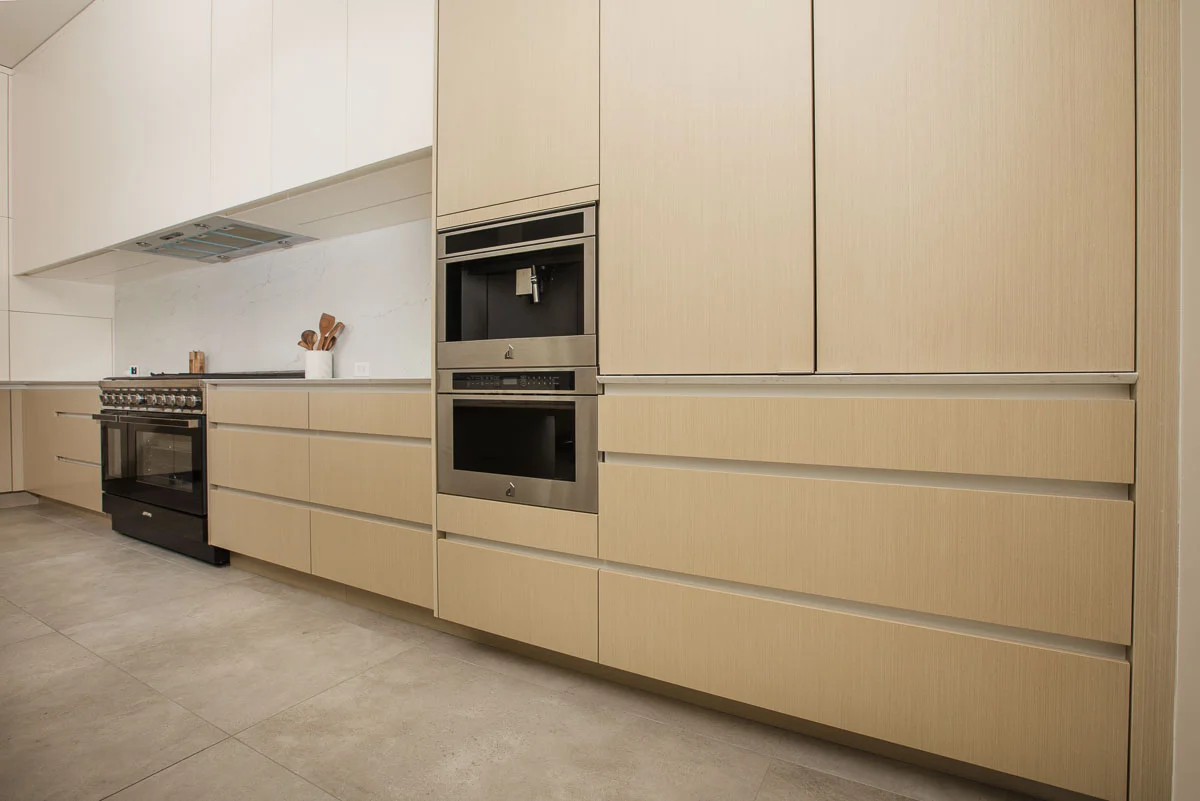
White oak has become the dominant species in California luxury kitchens, and for good reason. It is hard, stable, and naturally resistant to moisture. Rift-sawn white oak, with its straight, uniform grain, delivers a contemporary aesthetic that aligns perfectly with the clean-lined designs popular in Bay Area and Los Angeles homes. We source our white oak from FSC-certified mills in Pennsylvania and Oregon, selecting boards for consistent color and minimal sapwood.
Hard maple is another excellent sustainable choice, particularly for painted cabinetry. Its tight, closed grain accepts paint beautifully and resists the grain telegraphing that can occur with open-grained species like oak. Cherry, while less commonly specified today, remains a favorite for traditional and transitional kitchens. Its warm, reddish-brown patina develops naturally over time without the need for artificial staining, reducing chemical use during finishing. Visit our materials page to explore our full wood species selection.
Reclaimed and Salvaged Wood
Reclaimed wood carries zero harvesting footprint because it has already been extracted from forests decades or centuries ago. The character it brings to a kitchen is impossible to replicate with new lumber. Old-growth grain density, natural patina, and the subtle marks of previous lives -- nail holes, weathering, saw marks -- create surfaces with extraordinary depth and personality.
We regularly work with reclaimed Douglas fir, heart pine, and chestnut. A recent project in Sausalito featured reclaimed Douglas fir from a decommissioned railroad trestle for the island countertop and open shelving. The wood had spent 80 years outdoors, developing a silver-gray exterior that, once surfaced, revealed a rich amber interior with grain patterns you simply cannot find in modern timber. Another client in Woodside chose reclaimed American chestnut -- a species functionally extinct since the early 1900s blight -- for their cabinet door panels, creating a kitchen with genuine historical significance.
Working with reclaimed wood requires expertise. Each board must be carefully inspected for hidden metal, checked for structural integrity, and kiln-dried to eliminate any remaining moisture or insect concerns. The milling process is slower and more demanding than working with new lumber, but the results justify the effort. We maintain relationships with several reclaimed wood dealers in Northern California who specialize in sourcing and preparing salvaged timber for fine woodworking applications.
Bamboo and Rapidly Renewable Resources
Bamboo reaches harvestable maturity in 3-5 years, compared to 50-80 years for traditional hardwoods, making it one of the most rapidly renewable building materials available. Modern strand-woven bamboo is compressed under extreme pressure to create a material that is harder than red oak, dimensionally stable, and available in a range of tones from natural blonde to rich caramel.
We use strand-woven bamboo primarily for interior cabinet components -- drawer boxes, shelf surfaces, and pantry interiors -- where its hardness and moisture resistance are particularly valuable. For visible applications, it works beautifully as open shelving or as an accent material paired with traditional hardwoods. A kitchen we completed in Menlo Park combined white oak cabinet fronts with bamboo drawer interiors, achieving both the warm, contemporary look the client wanted and exceptional sustainability credentials.
Other rapidly renewable materials gaining traction include wheat straw-based MDF (marketed as Kirei Board) and sorghum-based particleboard. These products replace traditional wood-based panels with agricultural byproducts, are naturally formaldehyde-free, and perform comparably to conventional substrates. They are particularly well-suited for cabinet boxes and concealed structural components.
Sustainable Stone and Countertop Options
Countertop selection presents a significant sustainability opportunity. Locally quarried stone dramatically reduces transportation emissions compared to imported materials. California has excellent sources of soapstone, serpentine, and certain granites that rival any imported material in beauty and durability. Soapstone from the Sierra Nevada is a personal favorite -- its soft, warm surface develops a dark patina over time that complements both traditional and modern cabinetry.
Recycled glass surfaces from Vetrazzo are manufactured in Berkeley, California, making them essentially a local product for Bay Area installations. These surfaces incorporate post-consumer glass -- from wine bottles, windows, and even old traffic lights -- into a cement matrix, creating vibrant, colorful surfaces that are heat-resistant, durable, and genuinely unique. Each slab contains the equivalent of approximately 900 recycled bottles.
Porcelain slabs represent another sustainable frontier. Manufactured from natural clays and minerals, fired at temperatures above 2200 degrees Fahrenheit, they produce a material that is nearly impervious to stains, scratches, and UV degradation. At just 6-12mm thick, they use substantially less raw material than 3cm natural stone slabs. Brands like Neolith and Dekton have expanded their color ranges dramatically, now offering convincing reproductions of Calacatta marble, Carrara, and even oxidized metals.
Eco-Friendly Adhesives, Finishes, and Hardware
The smaller components of a kitchen -- adhesives, finishes, and hardware -- collectively have a meaningful environmental impact. We specify CARB Phase 2 compliant plywood exclusively, which limits formaldehyde emissions to 0.05 ppm, far below the levels associated with health concerns. Our edge-banding adhesive is a hot-melt EVA formula that contains no formaldehyde or solvents.
For finishes, natural oils -- tung oil, linseed oil, and hardwax oils from manufacturers like Osmo and Rubio Monocoat -- provide a beautiful, tactile surface with minimal environmental impact. These finishes penetrate the wood rather than forming a plastic film on top, which means they can be spot-repaired without stripping and refinishing entire surfaces. A small scratch or water ring can be sanded lightly and re-oiled in minutes, extending the life of the finish indefinitely.
Hardware longevity is an often overlooked aspect of kitchen sustainability. We specify Blum hinges and drawer slides as our standard, not just for their smooth operation but for their extraordinary durability. Blum tests their BLUMOTION hinges to 200,000 cycles and their TANDEMBOX drawer systems to 100,000 cycles with full load. This engineering-for-longevity approach means the mechanical components of your kitchen will outlast most other elements of the home. Learn about our complete approach to custom kitchen design.
Making Informed Choices
The sustainable materials landscape can feel overwhelming, but the decision-making framework is straightforward. Prioritize materials that are locally sourced, certified by recognized third-party organizations (FSC, GREENGUARD, CARB), engineered for longevity, and repairable. A kitchen built with these principles will not only be beautiful today but will remain relevant, functional, and valuable for generations.
During our design process, we guide clients through each material decision with samples, environmental data, and real-world performance information. We believe that informed choices lead to better outcomes -- kitchens that homeowners love more deeply because they understand and believe in every material that went into them.
Continue exploring sustainable kitchen materials
Related Articles
Wood Grain Matching Techniques
Achieving seamless visual continuity with natural wood species
Read More →Eco-Friendly Design Trends
The latest sustainable luxury trends shaping California kitchens
Read More →