Design Insights
Kitchen Islands: Design Evolution and Functionality
Discover the latest kitchen islands: design evolution and functionality shaping luxury kitchen design in California's most prestigious homes.
How a Simple Work Table Became the Heart of Luxury Kitchen Design
The Kitchen Island Through the Ages
The kitchen island has undergone a remarkable transformation over the past fifty years, evolving from a freestanding butcher block table into the single most important element in luxury kitchen design. In the California homes we work in today, the island is not merely a surface—it is a social hub, a cooking command center, a homework station, a bar, and often the architectural anchor of an entire open-plan living space. Understanding how the island evolved helps explain why it demands such careful design attention.
When we consult with clients across the Bay Area, Peninsula, and Southern California, the island is invariably the first thing they want to discuss. They have seen islands in magazines and on social media that captivated them—14-foot monoliths of bookmatched marble, curved sculptural forms in warm walnut, multi-level configurations with integrated cooktops and seating for eight. The possibilities are virtually limitless, which is exactly why the design process matters so much. A great island transforms a kitchen; a poorly designed one creates frustration every day.
For a deep dive into specific design ideas, see our comprehensive guide to kitchen island design ideas for large luxury homes. Here, we explore the broader evolution and the functional principles that make islands work beautifully.
From Worktable to Architectural Statement
The kitchen island as we know it emerged in the 1960s and 1970s when American home design began breaking down the walls that had traditionally separated the kitchen from living areas. Early islands were modest—a freestanding table or a peninsular extension of the countertop. They provided additional prep space and, for the first time, allowed the cook to face the family rather than standing with their back to the room.
The 1980s and 1990s saw islands grow larger and become permanently fixed elements with plumbing and electrical connections. Sinks moved to islands, followed by cooktops. By the 2000s, the oversized island—eight, ten, even twelve feet long—became the signature of luxury home design, particularly in California where open-plan living and indoor-outdoor flow made expansive kitchens both possible and desirable.
Today the island has reached a level of sophistication that would have been unimaginable a generation ago. We design islands with motorized elements, integrated technology, multiple materials, multiple levels, and custom storage systems that rival the finest furniture ever built. The island has transcended its utilitarian origins to become a piece of functional sculpture.
Functional Zones: How Modern Islands Work
A well-designed luxury island is organized into distinct functional zones, each optimized for a specific purpose. The prep zone typically occupies the center of the island, with a section of durable countertop—butcher block, quartz, or engineered stone—positioned between a prep sink and convenient access to knife storage. Below, deep drawers house cutting boards, mixing bowls, and prep containers within arm's reach.
The social zone is usually the side facing the living area, with a cantilevered countertop overhang for bar-height seating. We typically allow 24 to 30 inches of counter width per seat, with a 12 to 15-inch overhang for comfortable knee clearance. The best islands position this seating so guests have a view of both the cook and the television or fireplace in the adjacent living space—a detail that seems small but profoundly affects how the kitchen is used for entertaining.
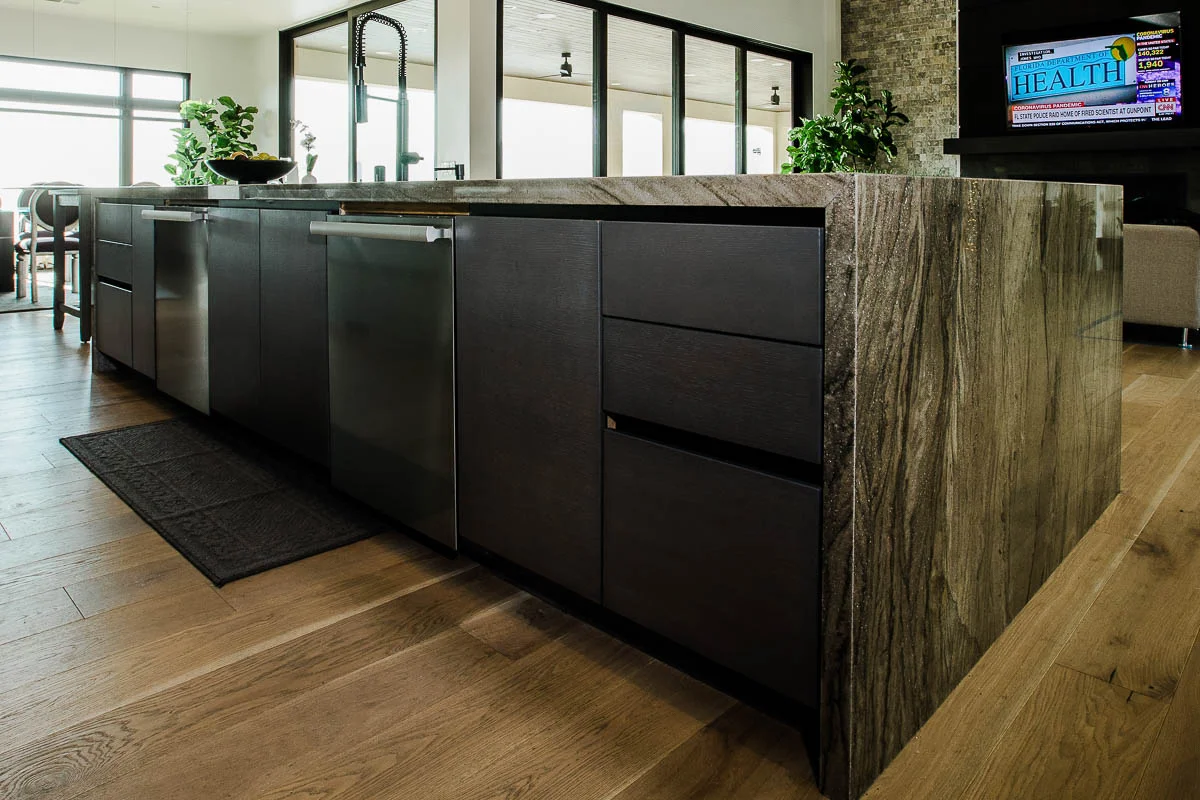
The storage zone occupies the interior of the island and is perhaps where custom cabinetry makes its greatest impact. We design islands with a combination of deep pot drawers fitted with Blum LEGRABOX slides, pull-out trash and recycling systems concealed behind cabinet faces, integrated spice drawers, cookbook shelves accessible from the seating side, and even refrigerated drawers for produce. Every cubic inch is assigned a purpose. Learn more about our approach to smart storage solutions.
Material Innovation in Island Design
The material palette for kitchen islands has expanded dramatically. While stone countertops remain dominant—marble, quartzite, and engineered quartz leading the way—we are increasingly incorporating wood, metal, concrete, and ultra-compact sintered surfaces into island designs. The trend toward mixed materials allows each surface to be optimized for its zone: a marble section for pastry work, a butcher block section for chopping, and a heat-resistant Dekton or Neolith surface around the cooktop.
For island base cabinetry, our clients frequently choose a different finish than the perimeter. A walnut island base with painted white perimeter cabinets is a perennially popular combination that creates visual hierarchy. Alternatively, we build island bases that reference furniture design—with turned legs at the corners, open shelving sections, and decorative panels that make the island read as a standalone piece rather than a continuation of the wall cabinetry. Explore the possibilities through our materials guide.
Sizing and Proportion: Getting It Right
One of the most common design mistakes in luxury kitchens is an island that is either too large or too small for the space. An oversized island in a modest kitchen creates cramped walkways and makes the room feel cluttered. An undersized island in a grand kitchen looks like an afterthought. Getting the proportions right requires careful measurement and, ideally, full-size mockups during the design phase.
We follow strict minimum clearances: 42 inches on all walkway sides, 48 inches behind seated guests so people can pass comfortably, and 60 inches in high-traffic paths between the island and major appliances. For a standard luxury kitchen of 400 to 600 square feet, an island of 8 to 10 feet long by 4 feet deep typically provides the ideal balance. Kitchens exceeding 700 square feet can accommodate 12-foot or longer islands—or even paired islands, a configuration growing in popularity for very large spaces.
The Double Island: A Growing Trend
For estate kitchens with ample square footage, the double island has emerged as an exciting design direction. Two parallel islands—typically 4 to 5 feet apart—allow one to serve as the primary cooking and prep station while the other functions as a social and serving surface. This separation keeps the mess of cooking contained on one island while guests enjoy a clean, uncluttered surface at the other.
We recently completed a double-island kitchen in Hillsborough where the cooking island featured an integrated Wolf induction cooktop, a prep sink, and deep storage drawers, all in dark-stained rift-sawn white oak. The social island, positioned facing the great room, was topped with a stunning slab of Taj Mahal quartzite and housed a beverage center with wine refrigerator, ice maker, and glassware storage. The two islands shared a material language but served completely distinct purposes.
The kitchen island will continue evolving as lifestyles change and technology advances. What will not change is the fundamental principle that great island design begins with understanding how you live—how you cook, how you gather, how you start your mornings and end your evenings. When those habits are translated into thoughtful cabinetry, storage, and surface design, the island becomes the heart of the home it was always meant to be. Explore our full custom kitchen services to begin designing yours.
Continue exploring kitchen design excellence