Design Insights
Kitchen Workflow Optimization Design
Learn about kitchen workflow optimization design for maximizing kitchen efficiency and organization.
The Science and Art of Kitchen Workflow Optimization
Designing for How You Actually Cook
A luxury kitchen can have the finest cabinetry, the most stunning stone, and every professional-grade appliance on the market—and still be frustrating to cook in. The difference between a kitchen that looks beautiful and one that works beautifully comes down to workflow: the logical sequence of steps required to prepare a meal and how the kitchen's layout supports or hinders that sequence. Workflow optimization is the invisible architecture of great kitchen design, and it is the first thing we address in every project.
The classic kitchen "work triangle"—the geometric relationship between sink, refrigerator, and cooktop—was developed in the 1940s and served well for decades. But modern luxury kitchens have outgrown this model. Today's kitchens often have two cooks working simultaneously, multiple sinks, separate beverage stations, and appliance suites that span an entire room. The work triangle has evolved into a work zone approach, where the kitchen is divided into specialized areas that each support a specific phase of the cooking process.
At PineWood Cabinets, we begin every design consultation with a detailed conversation about how our clients actually use their kitchen. Not how they think they should use it, but how they really do—from the morning coffee ritual to weeknight meal prep to Saturday night entertaining. This honest assessment drives every layout decision that follows.
The Five Essential Kitchen Zones
We organize every kitchen around five functional zones: storage, preparation, cooking, cleanup, and service. Each zone has specific cabinetry requirements, countertop material considerations, and proximity relationships with other zones. The storage zone encompasses the refrigerator, pantry, and dry goods storage. Ideally, the pantry is positioned adjacent to the refrigerator so that gathering ingredients for a recipe is a single stop rather than a series of trips across the kitchen.
The preparation zone is centered on the primary work surface—typically the island or a dedicated section of the perimeter counter—with immediate access to cutting boards, knives, mixing bowls, measuring tools, and a prep sink. We design this zone with deep drawers rather than cabinets with doors, because drawers bring their contents to you rather than requiring you to crouch and reach into a dark cabinet. Blum LEGRABOX drawers with 80-pound capacity can hold a full set of heavy mixing bowls and remain smooth and silent after decades of daily use.
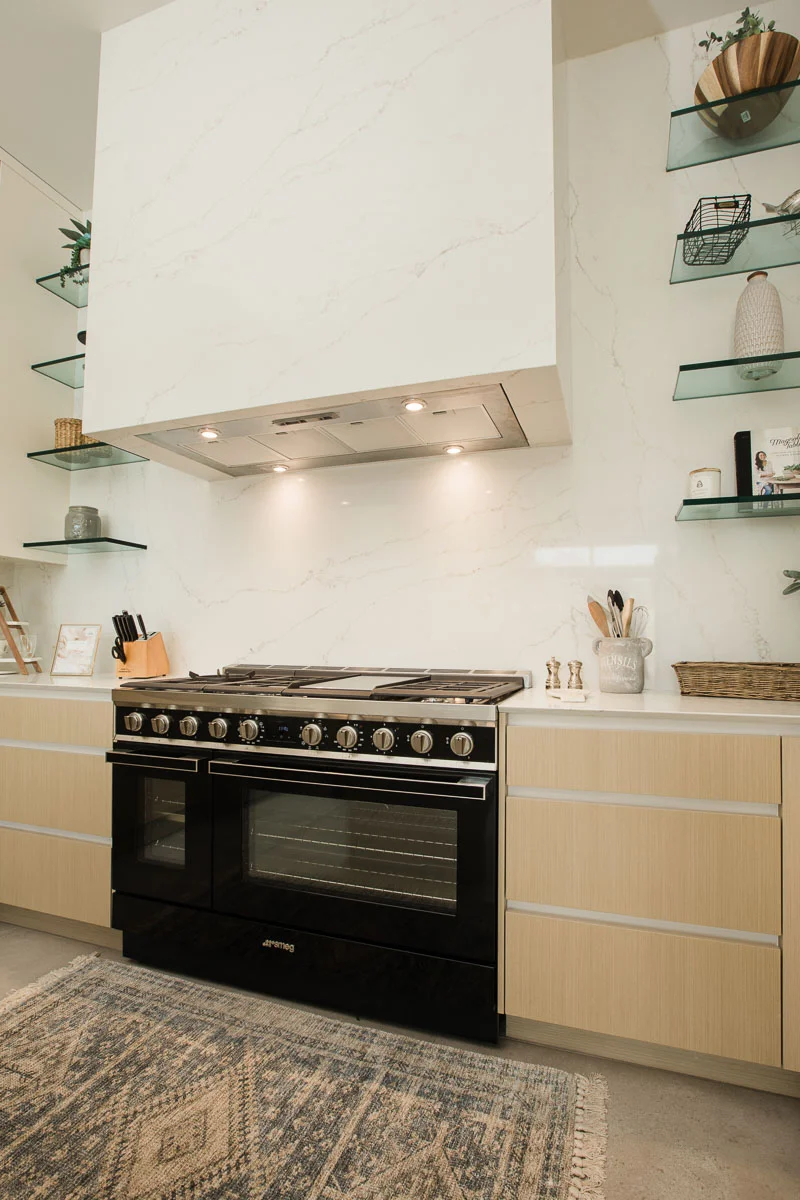
The cooking zone surrounds the range or cooktop and includes heat-resistant countertop surfaces on both sides (a minimum of 18 inches of landing space on each side of the cooktop), pot and pan storage directly below or adjacent, cooking utensils within arm's reach, and spice storage close enough to grab without stepping away from the stove. We often install a pot filler faucet on the wall behind the cooktop—it eliminates the need to carry heavy pots of water from the sink, a small luxury that serious cooks come to consider indispensable.
The Cleanup Zone: Often Overlooked, Always Important
The cleanup zone—centered on the primary sink and dishwasher—is frequently neglected in kitchen design, yet it is the zone that gets the most daily use. We position the primary sink with a clear view of the living area (no one wants to stare at a blank wall while washing dishes), with the dishwasher immediately adjacent on the dominant-hand side, trash and recycling within a step, and dish storage in upper cabinets or drawers directly above or beside the dishwasher so that unloading requires minimal movement.
The sink itself deserves careful consideration. For luxury kitchens, we recommend a large single-bowl sink (at least 30 inches wide) or a 36-inch workstation sink with integrated accessories—cutting boards, colanders, drying racks—that slide across the basin on built-in tracks. Brands like Rohl, Kohler Stages, and Franke Chef Center offer workstation sinks that essentially create an additional prep surface directly over the sink. This collapses the boundary between prep and cleanup, making both more efficient.
Two-Cook Kitchen Design
Many of our California clients—particularly busy professional couples—cook together regularly. A two-cook kitchen requires fundamentally different thinking than a single-cook layout. Each cook needs their own work zone with dedicated counter space, dedicated sink access, and enough room to operate without colliding. The most effective two-cook layouts place the primary cook at the range with a perimeter counter and sink, while the second cook works at the island with a prep sink and separate set of tools.
The minimum distance between facing counters for two-cook operation is 48 inches—enough for both people to have drawers open simultaneously without blocking each other. We recommend 54 to 60 inches where space allows. Storage is also duplicated: two sets of frequently used knives, two accessible spice locations, and shared access to the refrigerator from both zones. This approach transforms cooking from a solo activity into a social one, which is precisely what our clients want.
The Service and Entertaining Zone
The service zone is unique to luxury kitchens and addresses the transition from cooking to presenting and serving food. This zone typically includes a generous landing area for plating, warming drawers to hold finished dishes, and a pass-through or serving counter that connects the kitchen to the dining area. We design the service zone at the natural endpoint of the cooking workflow—food flows from prep to cooking to plating and out to the table without backtracking.
For clients who entertain frequently, we integrate a dedicated beverage station into the service zone. This typically includes a wine refrigerator, beverage cooler, ice maker, small bar sink, and glassware storage—all positioned so guests can help themselves to drinks without entering the cooking zones. The beverage station is often located at one end of the island or in a separate butler's pantry, keeping social traffic separated from the working kitchen. See our article on multi-purpose kitchen spaces for more on designing for cooking and entertaining simultaneously.
Storage Placement: The 80/20 Rule
We apply what we call the 80/20 rule to kitchen storage: the 20% of items you use 80% of the time should be stored within arm's reach of where they are used. Everyday plates and glasses go in drawers or cabinets adjacent to the dishwasher. Cooking oils, salt, and pepper are stored in a pull-out beside the cooktop. Cutting boards live in a vertical slot beside the prep sink. Rarely used items—the turkey roaster, the fondue pot, the holiday serving platters—can be stored in upper cabinets, deep pantry shelves, or adjacent butler's pantries where accessibility is less critical.
Custom cabinetry makes this precision possible in a way that stock cabinets cannot. We build drawer inserts sized to the client's actual knife collection, spice drawer organizers calibrated to their spice jar sizes, and pull-out shelving heights adjusted to accommodate their specific stand mixer and food processor models. This level of customization is the essence of what we do at PineWood Cabinets, and it is what makes the difference between a kitchen that works and one that works perfectly. Explore our full range of smart storage solutions and custom kitchen services.
Continue exploring kitchen design excellence